
Guides · CombiSteel Knowledge Hub
CombiSteel Stainless Worktable Cleaning and Maintenance (Models 7333.0063 and 7490.0060)
Learn effective cleaning and maintenance techniques for CombiSteel stainless worktables in Irish professional kitchens. Keep surfaces safe and durable.
In this guide
You rely on a stainless worktable for safe prep and fast service. But the wrong cleaner, leftover residue, or leaving the surface damp can lead to discolouration. And if a shelf gets overloaded during service or clean-down, it can bend.
This guide sticks to what CombiSteel actually states in its worktable manual: clean regularly using a cleaning agent suitable for stainless steel and galvanised surfaces, remove all cleaning-agent residues, and dry thoroughly so the table is never left damp. It also includes the two explicit safety warnings from the same manual: take care around exposed metal edges, and do not overload the tabletop or shelf.
Where model detail matters, we use two representative examples from the CombiSteel range: 7333.0063 and 7490.0060.
What you can and cannot take from the manufacturer guidance
CombiSteel’s worktable manual is clear on the constraints that protect the finish and the structure. It does not give a step-by-step hygiene method, chemical brands, dilution rates, contact times, or a daily versus weekly schedule.
So in this guide:
- Anything presented as a “must” comes directly from the manual.
- Anything about timing and routines is framed as an operational choice, because CombiSteel only says “clean regularly”.
Primary source: CombiSteel worktable assembly and cleaning manual (PDF).
Model snapshot: what matters for cleaning and day-to-day care
Knowing your exact model matters because rated loads and layout change how a table gets used (and abused).
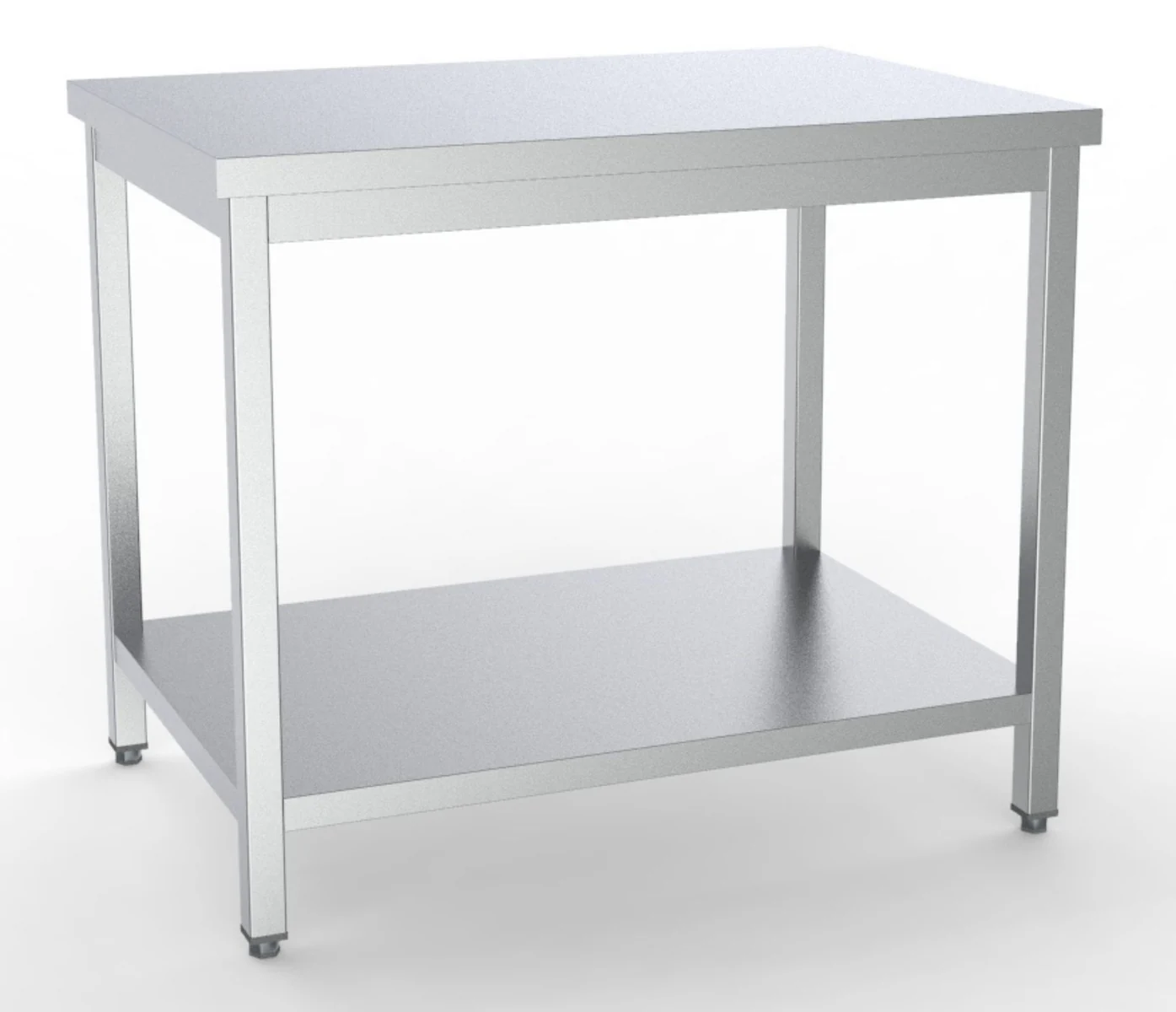
CombiSteel 7333.0063 (600 series worktable with bottom shelf)
From the verified product spec:
- Supplied flat packed
- Made from stainless steel 430
- Size: 900 x 600 x 850 mm
- Overall height adjustable: 850 to 900 mm
- Bottom shelf maximum load capacity: 300 kg
Source: Caterboss listing for CombiSteel 7333.0063.
CombiSteel 7490.0060 (700 series worktable with rear upstand and bottom shelf)
From the verified product spec:
- Supplied flat packed
- Rear upstand and a bottom shelf
- Size: 700 x 700 x 850 mm
- Top rated to 200 kg
- Bottom shelf rated to 50 kg
Source: Caterboss listing for CombiSteel 7490.0060.
Manufacturer safety notes you should build into cleaning and handling
These are the two safety points CombiSteel calls out explicitly:
- Exposed metal edges: “Whilst all care has been taken to remove sharp edges, care must be taken when cleaning or handling to prevent risk of injury from exposed metal edges.”
- Overloading: “Do not overload the table top or shelf causing it to bend.”
Source: CombiSteel worktable manual (PDF).
Operationally, that means two simple habits help a lot:
- When wiping undersides, corners, frames and the shelf, slow down and mind your hands.
- Keep the load ratings visible for the team, especially where the undershelf becomes “temporary storage” during a rush.
CombiSteel cleaning principles (what the manual actually requires)
The manual gives three non-negotiables:
- Clean regularly using a cleaning agent suitable for use with stainless steel and galvanised surfaces.
- Always remove cleaning-agent residues, because residue can discolour the surface.
- Never leave any surface damp, as this may cause discolouration.
Source: CombiSteel worktable manual (PDF).
Before first use
CombiSteel also gives a specific first-use instruction:
- “Before using for the first time we recommend the table is cleaned thoroughly with a suitable cleaning agent. Remove all cleaning residues and dry thoroughly.”
Source: CombiSteel worktable manual (PDF).
How load ratings should influence everyday use and ongoing condition
The manual warning is deliberately broad: don’t overload the top or shelf because it can bend. Your model ratings tell you where the pinch points are.
- With 7490.0060, the bottom shelf (50 kg) is the tight limit. It is easy to exceed without thinking, particularly if you park equipment or heavy ingredient boxes there.
- With 7333.0063, the bottom shelf rating is higher (300 kg), but the manual warning still applies. Staying under a stated maximum does not remove the need to distribute load sensibly or keep the table stable.
Sources:
- 7490.0060 ratings: Caterboss product page
- 7333.0063 shelf rating and construction: Caterboss product page
- Overload warning: CombiSteel worktable manual (PDF)
If you are using a worktable as an equipment stand, check the support question separately: CombiSteel Worktable Shelf Load & Appliance Support.
A practical routine you can run in an Irish kitchen (kept within the manual constraints)
CombiSteel’s requirement is simply “clean regularly”. The schedule below is a usable three-level pattern many kitchens run. Treat it as an operational template, not a CombiSteel instruction.
At every level, keep to the manual constraints: use a cleaning agent suitable for stainless steel and galvanised surfaces, remove residues, and dry thoroughly so the table is not left damp. (Manual: PDF)
Level 1: during service (when-soiled / between tasks)
Use this level whenever the surface is visibly soiled, or when your own HACCP routine calls for a change of task.
- Clean the affected area using an agent suitable for stainless and galvanised surfaces.
- Remove cleaning-agent residues.
- Dry thoroughly so you are not leaving damp patches behind.
- Work carefully around corners, frames and undersides due to the manual’s sharp-edge warning.
Level 2: end-of-shift (your “regular” clean)
This is where most tables get damaged, because people rush and leave chemical residue or water behind.
- Clean the tabletop and any areas that get handled frequently (front edge, upstand if fitted, and shelf surfaces).
- Remove cleaning-agent residues fully.
- Dry thoroughly so the table is not left damp overnight.
- As you clean, keep an eye out for early signs of misuse: dents, racking, or a shelf starting to bow. If you see bending, the manual warning points you back to loads and handling.
Level 3: periodic deeper clean (weekly, or as your operation needs)
This is for the parts that are easy to ignore until they look tired: corners, frames, the underside of the top, and the shelf supports.
- Plan it at a quiet time so you are not cleaning around stacked stock. The manual warns against overloading, and moving piles around mid-clean is where people end up over-stressing a shelf.
- Clean using an agent suitable for stainless and galvanised surfaces.
- Remove residues.
- Dry thoroughly, including ledges and junctions where water likes to sit.
Where to layer in Irish food-safety requirements
Your HACCP plan and any FSAI/HSE-aligned site procedures should set the actual frequencies and any task-based hygiene rules for food-contact prep areas.
Use the three levels above as the structure, then plug in:
- your site’s required cadence (for example, “between raw and ready-to-eat prep”), and
- the chemical label instructions your operation follows,
while still meeting CombiSteel’s finish-protection requirements: suitable agent, residues removed, and no damp left behind. (Manual: PDF)
If you are still sizing a table for your section and want to avoid it turning into a dumping ground, see: CombiSteel Stainless Worktable Sizing Best Practices.
Worked example (hypothetical): checking a cleaner choice and loads on 7490.0060
This example shows how to apply the verified limits without inventing chemical methods or a hygiene procedure.
Known (from sources):
- Model in use: CombiSteel 7490.0060 (rear upstand, bottom shelf), supplied flat packed.
- Rated loads: top 200 kg, bottom shelf 50 kg.
- Cleaning constraints: use a suitable agent (stainless + galvanised), remove residues, and dry thoroughly. Never leave the surface damp (manual PDF).
Assumed inputs (your site will differ):
- The table is used for general prep and as a short-term holding bench during service.
- Your team plans to use a cleaner where the label states “suitable for stainless steel”, but does not mention galvanised surfaces.
- During close-down, you intend to park two appliances on the bottom shelf with a combined weight of 60 kg.
Decision checks:
- Cleaner suitability: not confirmed. The manual requires a cleaning agent suitable for stainless steel and galvanised surfaces. If the label does not cover both, you cannot treat it as compliant with the manual wording. Choose an alternative or get confirmation from the chemical supplier before using it on the table.
- Shelf load: reject as planned. The bottom shelf is rated to 50 kg, and 60 kg exceeds that limit.
- Finish step: required every time. Once cleaned, residues must be removed and the surface must be dried so it is not left damp, per the manual.
The point is not to guess what should be fine. It is to check the two most common causes of avoidable damage on-site, chemical compatibility and load limits, against the wording CombiSteel provides.
Next step: confirm guidance for your exact model
Use the manufacturer document for the table you have on-site, and stick to what it actually says.
- Manual: CombiSteel worktable manual (PDF)
- Model reference points.