
Guides · CombiSteel Knowledge Hub
CombiSteel Extraction Hood Clearances & Filter Access FAQ
Discover essential CombiSteel extraction hood info for Irish kitchens: sizing, filter access, and care advice.
In this guide
If you are planning a CombiSteel wall-mounted extraction hood, clearance and access are what usually decide whether it will work day to day.
Two checks matter early:
- Coverage: the hood must fully cover the cookline.
- Filter access: you need to be able to remove the grease filters easily enough that they actually get cleaned or replaced.
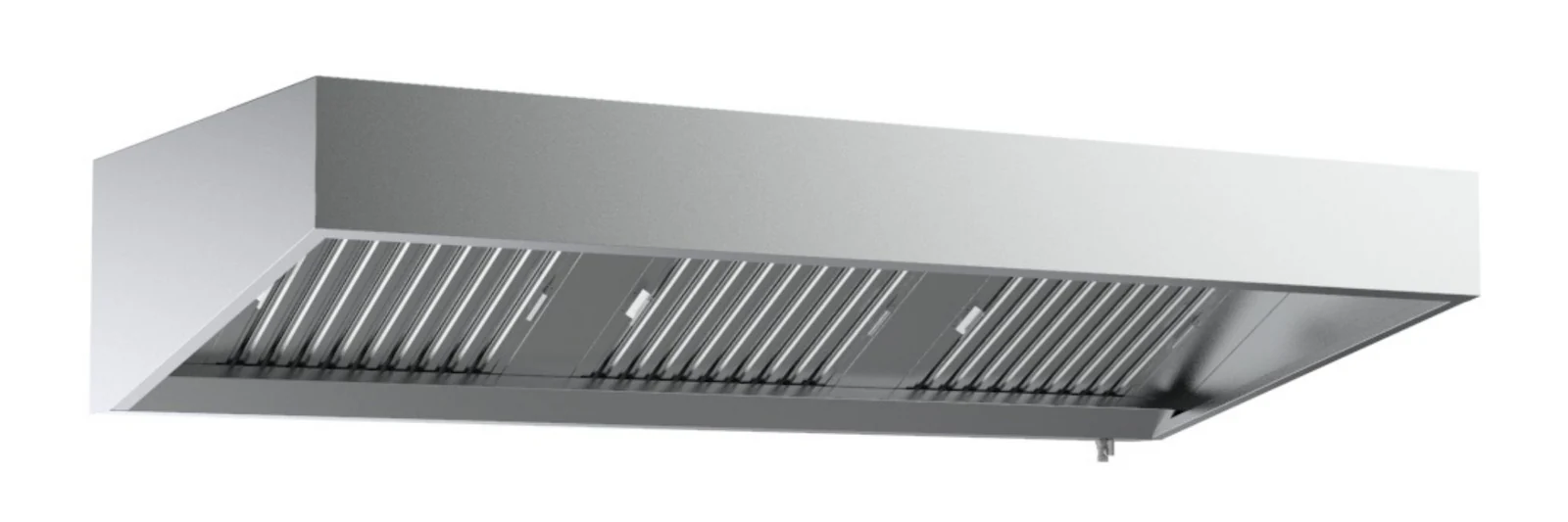
Two CombiSteel wall hoods illustrate the differences between a canopy with a built-in fan and one that requires a separate fan and controller.
The CombiSteel 7333 series installation instructions, pages 4–5 (PDF) give mounting distances and side overhang for the wall-mounted series. Have your installer check which instructions apply to your exact hood and cooking appliances, including the space needed to remove the filters.
Introduction to CombiSteel hoods
An extractor hood is the canopy over your cookline that removes grease-laden air, steam, smoke and cooking odours.
Wall-mounted canopies, box hoods and condensation hoods serve different duties. When comparing complete canopies, check whether the model includes its own fan and lighting.
Sizing your extraction hood (start with width)
Caterboss’ selection rule is the starting point:
“Measure the width of your cookline and select extractor hoods that fully cover all hobs, fryers, grills and ovens.”
(Extractor Hoods category page)
That single line is the sizing decision you can safely take from the source. If the hood does not fully cover the line you are extracting, you are into a different width (or multiple hoods), regardless of brand.
Settle these two design choices with your installer:
- Decide between internal fan units and external fan systems.
- Consult your ventilation or gas installer on ductwork and local regulations.
If you are still building out the cookline spec, do that first. This is where a layout check like balance a CombiSteel cooking line (hobs, fryers, griddles) helps you lock down what needs extraction.
Filter maintenance and access (what to compare on the listing)
Make space to withdraw the grease filters for cleaning. Use the filter-care instructions supplied with the exact hood and agree a cleaning schedule appropriate to the cooking duty.
The product pages here do not describe exactly how filters release or whether tools are needed. What you can compare reliably is the number of filter panels and their size, which directly affects the handling workload.
- CombiSteel 950 Wall-Mounted Extractor Hood Complete with Fan 1000 (7333.0730) is listed with 1 filter at 495 × 495 × 25 mm (7333.0730 technical details).
- CombiSteel 1100 Wall-Mounted Extractor Hood 2000 (7333.1145) is listed with 3 filters, each 495 × 495 × 25 mm (7333.1145 technical details).
Both models are also listed with Lights: Yes and Tap: Yes on their technical details pages.
Model comparison: 7333.0730 vs 7333.1145 (what changes commercially)
These two CombiSteel wall hoods suit different types of fit-out. The practical difference is where the extraction “system” lives.
7333.0730: integrated fan and controls (1000 mm wide)
On the Caterboss listing, 7333.0730 is shown with Engine: Yes and Controller: Yes, plus Tap: Yes, Lights: Yes and Plug and play (EU only): Yes.
It is listed as:
- Dimensions: (H)520 × (W)1000 × (D)950 mm
- Material: Stainless steel 430
- Particulars: Maximum intake air temperature: +50°C
- Capacity in m³ air/hour: 500 (max)
Commercially, this points to a more self-contained hood for shorter runs, where it suits the cookline width and the rest of the design.
7333.1145: canopy-only (2000 mm wide), fan and controls specified separately
On the Caterboss listing, 7333.1145 is shown with Engine: No and Controller: No, while still listing Lights: Yes and Tap: Yes.
It is listed as:
- Dimensions: (H)400 × (W)2000 × (D)1100 mm
- Material: Stainless steel 430
- Filters: 3 × 495 × 495 × 25 mm
The product description positions it as a hood that traps heat, smoke and odours which are then transitioned outside as part of the ventilation setup.
Commercially, this is the kind of hood you specify as part of a wider extraction design. Because Engine: No / Controller: No, you must specify a separate fan and control solution as part of that design.
Worked example (hypothetical): a 2.6 m wall cookline
This example is hypothetical and only uses the selection logic and model facts stated on the Caterboss pages.
Scenario: You have a wall cookline made up of:
- Two 400 mm fryers
- One 900 mm griddle
- One 900 mm range
Total appliance width: 2,600 mm.
Measure the complete width of the hobs, fryers, grills and ovens in use. The canopy must cover this area with the additional overhang required for the installation.
What that means for these two example hoods (based on width alone):
- 7333.0730 is 1000 mm wide, so it will not fully cover a 2,600 mm line.
- 7333.1145 is 2000 mm wide, so it still does not fully cover a 2,600 mm line.
So the decision here is not which of these two is “best”. It is that your line needs a wider hood option (or multiple hoods) to meet the “fully cover” rule. Once width is solved, you then choose between:
- a hood format with Engine/Controller included (like 7333.0730, listed as Engine: Yes / Controller: Yes), or
- a canopy-only hood where Engine/Controller are not included (like 7333.1145, listed as Engine: No / Controller: No), meaning the fan and controls are specified elsewhere.
Filter handling reality (based on the listings):
- 7333.0730: 1 filter panel (495 × 495 × 25 mm).
- 7333.1145: 3 filter panels (3 × 495 × 495 × 25 mm).
Depth also differs between these models, at 950 mm and 1,100 mm. Ask the designer to check capture and access against the actual cooking duty.
If you want a structured way to gather the right inputs before you commit to a canopy width and fan approach, use the commercial kitchen extraction planning guide as your checklist.
Installation and compliance considerations (what the sources support)
The wall-canopy instructions give both an overhang and a mounting distance. Ask the installer to confirm them against the final appliance layout before fixing the height.
What Caterboss does support is the decision flow:
- choose between internal fan units and external fan systems
- consult your ventilation or gas installer to ensure compatibility with ductwork and local regulations
- plan for periodic duct and fan cleaning with a professional contractor
Keep the matching hood instructions, service-access details and installer’s design and sign-off with the kitchen records.
Next step: shortlist by width, then decide on fan approach
Start with a measured cookline width and shortlist hoods that fully cover it, as Caterboss advises. Then use the product pages to confirm whether a given hood is listed with Engine/Controller included, or whether it is a canopy intended to be paired with a separate fan/control solution.
Keep the hood model code, the measured cookline and the installer’s proposed fan arrangement together when comparing quotes.