
Pizzeria · CombiSteel Knowledge Hub
Plan a Rush-Ready Pizzeria Work Line with CombiSteel Oven and Counter Choices
Learn to design a pizzeria workflow that optimises speed and order handling during rush hours.
In this guide
When the printer spikes, your pizzeria line either flows or it bottlenecks at make, bake, or dispatch. This guide helps you plan a work line that holds together in a rush by designing around your busiest 15 minutes, not your daily totals.
You’ll:
- map your order waves so you design for the real pressure points
- sanity-check cooking format using diameter-qualified examples: the CombiSteel 7485.0020 deck oven (specified as 9 pizzas at 30 cm) versus the 7485.0150 conveyor oven (published diameter-based hourly figures)
- position and stock a make-line counter like the CombiSteel Counter 700 refrigerator 7489.5520 to cut mid-rush restocking trips
- protect the landing, cutting, boxing, and collection area so finished pizzas do not jam the oven exit
Understanding Your Order Traffic
Plan the line around your busiest 15 minutes, not your busiest day.
Pull at least two weeks of order history from your POS and delivery platforms and keep the timestamps intact. Then map what lands in the busiest 15, 30, and 60 minutes, split by channel, pizza size, and the modifiers that slow you down. This gives you an order-wave view you can design around, and it quickly shows whether your first pinch point is make, bake, or dispatch.
1. Pull the right data (daily totals won’t show the spikes)
Daily sales and covers hide the real issue, which is clustering.
Export tickets for a minimum of 14 days and include:
- time received (and promised time if you have it)
- channel: dine-in, collection, delivery apps, pre-orders
- items: pizzas, sides, dips, drinks
- notes and modifiers
If you take pre-orders, keep them in, but tag them. They hit the kitchen differently to walk-ins and app orders.
2. Turn orders into waves you can plan and staff for
You are not trying to predict every ticket. You are trying to identify repeatable bursts that overload the line.
For each 15-minute band in your peak window (often 18:00 to 21:00), track:
- orders per 15 minutes, by channel
- pizzas per order (singles vs bundles)
- size mix (your most common diameter)
- high-friction builds (half-and-half, gluten-free bases, heavy toppings, lots of customisation)
- what else rides with the pizzas (sides, dips, drinks) that steals time at dispatch
When you can point to the worst 15 minutes and say “this is what hit us”, you have a usable design target.
3. Time the work around the pizza, not just the bake
A pizzeria can have plenty of heat and still get buried on labour minutes.
Do a quick, honest time check for your operation:
- make time: stretch, sauce, top, label, stage for bake
- dispatch time: cut, box, check, bag, hand off (including dips and drinks)
Time it once at normal pace, then watch it during a live rush. What usually changes is interruption rate: restocking mid-wave, questions at the pass, missing tickets, and people reaching across each other.
4. Find the rush breakers that create queues
Most lines don’t fail because the team can’t work. They fail because two peaks land together with no buffer.
Common triggers worth spotting in your data and on the floor:
- delivery-app batches landing as dine-in tables order together
- a courier wave arriving while you are trying to hand over collections
- boxing running low mid-wave
- tickets printing in two places and getting out of sequence
- a collection queue blocking the handover point
Fixing one or two usually buys you more throughput than telling staff to “move faster”.
5. Convert the wave into a capacity target you can test
Write your output target as pizzas per 15 minutes, with assumptions stated clearly:
- typical size mix and complexity
- channel split (how many are leaving the building vs being served)
- what else must be packed with each order
That target becomes the benchmark for staffing, bench space, and handover space.
If you like planning with manufacturer-published outputs (useful as a reference, not a Friday-night guarantee), see how we handle published figures and real-world constraints in: CombiSteel ice machine output and bin capacity.
Pizza Oven Capacity in Real-Life Scenarios
Your line only stays calm in a rush if the oven’s real constraint matches what your team can load, turn and clear without hesitation.
At a practical level:
- A deck oven is limited by how many pizzas fit on the deck at your chosen diameter.
- A conveyor tunnel oven is limited by a published throughput, and that throughput changes with diameter.
If you want wider context on oven formats and what they mean for workflow, see: Compare commercial oven formats.
How do the CombiSteel 7485.0020 and 7485.0150 compare overall?
The planning difference is simple:
- CombiSteel 7485.0020 (deck): you plan around simultaneous capacity, and that capacity is diameter-qualified.
- CombiSteel 7485.0150 (conveyor): you plan around diameter-qualified hourly figures published in the technical data.
In Irish service, that matters because peaks are often short and sharp. A small stutter at loading or unloading quickly shows up as delayed promised times.
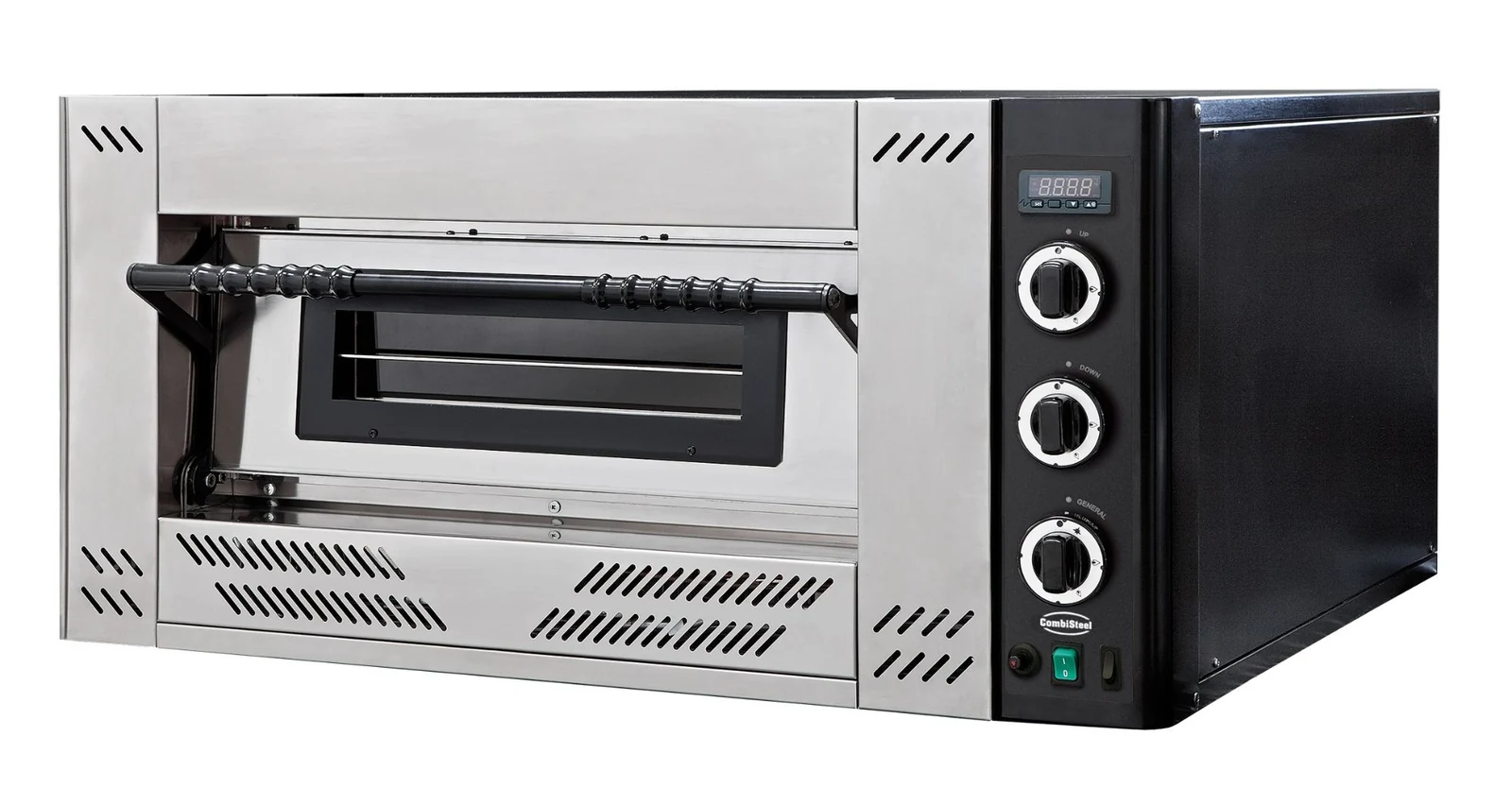
CombiSteel 7485.0020 (single-deck gas pizza oven)
For a standard 30 cm pizza, the 7485.0020 is specified at 9 pizzas, with the diameter called out alongside the count on the product listing: “Number of pizzas: 9” and “Measurement pizza ø cm: 30” (Caterboss product listing).
That “9 at once” is useful for staffing because you can run the oven as nine live slots and pace stretching and topping to keep those slots working.
The catch is treating “9 at once” as a fixed pizzas-per-hour number. Real output moves with bake time, door openings, and whether one person is trying to load, rotate and unload while also handling tickets.
CombiSteel 7485.0150 (conveyor tunnel oven)
The 7485.0150 technical data publishes diameter-specific rates of:
- 25 cm: 30 pcs/h
- 32 cm: 15 pcs/h
- 40 cm: 13 pcs/h
(Source: CombiSteel 7485.0150 technical data sheet, p.2)
That diameter effect is the planning headline. If you push larger sizes during a busy period, the oven can become the bottleneck even when the make bench feels on top of things.
Treat the hourly figures as published manufacturer figures, not a promise for every site. In practice, rate drops when the belt is under-fed, toppings are heavy, or staff slow down to protect quality and avoid collisions. The upside is at the pass: pizzas arrive in a more predictable rhythm, which helps cutting and boxing stay organised.
Which is best for you?
- Choose a deck-style approach (7485.0020) if you mainly sell one diameter and you want an intuitive “slots on the deck” way to run a rush, accepting that output depends heavily on who is working the oven.
- Choose a conveyor-style approach (7485.0150) if your operation benefits from a steadier stream to cutting and boxing, and you want diameter-based figures to sanity-check menu sizing and service expectations.
Strategically Positioning the Refrigerated Counter
Position the CombiSteel counter 700 refrigerator 7489.5520 as part of the pizza make station, not as a general kitchen fridge. Then stock it so the topping person can work in a consistent build order with minimal door opening during the rush.
The aim is simple: fewer steps, fewer collisions, and less time standing with drawers and doors open while service is flying.
1. Place it to serve one station, not the whole kitchen
At (H) 850 x (W) 1865 x (D) 700 mm, the 7489.5520 is a proper counter footprint, so it needs a defined job in the line rather than becoming a communal grab point (dimensions per the CombiSteel 7489.5520 listing).
In a typical setup, it sits on the make-line side where the stretch and top station can:
- open drawers without stepping back into traffic
- stay clear of the oven landing and boxing area
Reality check: in a busy five minutes, nobody should be squeezing behind the topping station to reach chilled ingredients unless they are the person assigned to restock.
2. Use drawers for speed, doors for reserve
The value in this unit is the mixed layout: 2 doors and 2 drawers (configuration per the CombiSteel 7489.5520 listing).
Use it to separate “grab-and-go” from “planned top-up”:
- Drawers: the high-turn items you touch constantly during service.
- Doors: backup stock and unopened packs that should only be accessed on a controlled refill.
3. Stock it in build order and keep formats consistent
Pick your standard build sequence and mirror it inside the counter so hands move the same way every time. It is not about perfection, it is about removing decision points when the printer is spitting orders.
This model is specified for GN 1/1 format, so keep your inserts and containers consistent where you can (GN format per the CombiSteel 7489.5520 listing). Fewer container types usually means faster restocking and fewer mistakes when staff rotate onto the section.
4. Set a restock rule to prevent mid-rush searching
With 474 litres gross capacity, you can hold meaningful on-line stock, but only if replenishment is disciplined (gross capacity per the CombiSteel 7489.5520 listing).
A simple rule that works in busy takeaways and casual dining:
- One person is responsible for topping up at defined moments.
- The topping person does not leave the bench to hunt for product.
- Backup comes from the door section, and drawers get refilled quickly and closed again.
5. Keep it out of the dispatch lane
Avoid placing the counter in the same zone as cutting, boxing, and collection. That area is hot, noisy and full of turning bodies. Open drawers and doors become collision points.
If you are choosing between “closer to the oven” and “clean access for topping”, prioritise clean access for topping, and keep the oven exit as its own landing and dispatch path.
Managing Order Waves with a Worked Occupancy Example
A 15-minute rush is rarely an “oven problem” on its own. It is a work-in-progress problem between stretch, top, bake and box.
The point of the example below is not to claim bake times or pizzas-per-hour. It is to show how quickly a rush can outrun your available oven space, and why you need a rule for how much work you allow to build up between make and bake.
Worked 15-minute wave (30 pizzas) with deck-slot occupancy
Hypothetical inputs (fixed for this example):
- Orders in window: 30 pizzas in 15 minutes
- Oven constraint: CombiSteel 7485.0020 is specified as 9 pizzas at 30 cm
- In-flight at minute 0: 12 occupied positions already in the system
- Occupancy time per position: 6 minutes (each “position” is tied up for 6 minutes once you commit a pizza to the bake flow)
To keep the maths consistent, this is a simple batch view: the deck can only clear a maximum of 9 pizzas each 6-minute cycle.
Step 1: turn the wave into arrival pressure
30 pizzas in 15 minutes is 2 pizzas per minute arriving into the system.
Step 2: state the starting queue clearly
If you already have 12 pizzas in-flight at minute 0 but the deck only has 9 slots, then 3 pizzas are already waiting to be baked at the start.
Step 3: carry the backlog through each cycle (no fractional pizzas)
- Minute 0: backlog waiting = 3
- Minute 0 to 6: new arrivals = 12. Deck clears 9 at minute 6. Backlog becomes 3 + 12 − 9 = 6
- Minute 6 to 12: new arrivals = 12. Deck clears 9 at minute 12. Backlog becomes 6 + 12 − 9 = 9
- Minute 12 to 15: new arrivals = 6. In this 3-minute partial window, you do not get a full 6-minute clear cycle in this simplified model. Backlog becomes 9 + 6 = 15
Those numbers are not a bake-time promise or an approved throughput figure. They are what happens in a queue when incoming work is higher than what the line can clear.
Practical takeaway for the floor
If you see build-up between make and bake, you need a visible cap and a holding method that does not trash quality or block movement.
Instead of a fixed “3-base cap” (which only matches the starting shortfall), your cap needs to reflect how far behind you are and how much clean staging space you actually have. If you cannot stage that backlog neatly, you have two realistic options in the moment:
- slow the make station so you stop creating dressed bases that cannot be loaded
- add capacity or change the bake format so the oven is not the limiter in that wave
Deck vs conveyor during a wave: what changes in how you pace the line
- With a deck oven: output tends to arrive in batches. Your risk is overbuilding on the bench while waiting for space.
- With a conveyor tunnel oven: your job is keeping the feed steady and protecting the exit. The CombiSteel 7485.0150 technical sheet shows diameter-dependent figures (25 cm, 32 cm, 40 cm), which is why they are useful for planning, but they are still just published figures (technical data sheet, p.2).
Optimising the Final Stages: Cutting, Boxing, and Collection
A pizzeria can lose more time in the last 20 seconds than it ever gains at the oven.
Place a fixed landing surface at the oven exit, then set cutting and boxing immediately beside it so the oven loader can unload without stepping into the dispatch lane. Keep collection and driver pickup out of the hot zone, with one clear handover point.
Set roles by station (loader, cutter, packer, runner) so you can add hands during a rush without moving equipment. A quick pre-service walk-through will usually catch the avoidable stuff: boxes in the wrong place, labels missing, bins blocking the route, or a “temporary” stack of bags that becomes permanent.
1. Keep the oven exit landing zone clear
You need a dedicated landing surface where pizzas can sit for seconds while you check the docket, confirm the cut, and spot anything that needs a re-fire. Treat it as a working area, not storage:
- no stacks of boxes
- no sauce bottles or shakers
- no order bags
- no utensils that belong elsewhere
2. Put cutting and boxing beside the landing, not in front of it
Set the cutting board and boxing surface directly beside the landing zone. The pizza should move sideways once, then forward into the box.
The benefit is practical: the oven loader can always unload, even if cutting is briefly behind.
3. Separate collection from production with one handover point
Collection should not happen at the oven mouth or leaning over the boxing bench. Put your pickup shelf, hot-hold, or bag racking to one side so customers and delivery drivers aren’t sharing space with the cutter and packer.
One clear handover point cuts mistakes and stops the queue drifting into your working footprint.
4. Standardise the last 20 seconds so accuracy holds up under pressure
Once the stations are fixed, make the finishing routine predictable:
- Ticket check at landing
- Cut and box
- Label and bag
- Move to collection
Decide in advance where problem pizzas land (wrong topping, remake, missing dip) so they do not block the landing zone.
FAQs for planning a rush-ready pizzeria work line
How many peels or screens do I need for a 15-minute wave?
Plan for the point where your oven capacity forces you to stage product.
- Deck operation: if you’re running a 9-slot deck, your limit is not “as many as you can find”. It is whatever keeps you loading and unloading without cluttering the bench.
- Use the worked example logic: if your wave keeps arriving faster than the oven can clear, the waiting product will grow. That means you need a defined place to hold work and a rule for when the make station stops feeding dressed bases into a full queue.
The tell on a busy night is simple: if peels are leaning everywhere and people are stepping around bases, your line is running on improvisation.
How do I stop couriers and collections blocking the pass?
Make it one-way and boring.
- Put a single handover point away from the oven exit and boxing bench.
- Keep a clear waiting line that does not overlap the route your runner uses.
- If you have space, split “ask a question” from “collect an order”. Questions at the handover point slow everything.
If you can’t change the footprint, change the rule: couriers do not approach the bench. They wait, your runner calls names or numbers, and the order leaves production only when it is bagged and checked.
What’s a simple ticket and labelling routine that holds up under pressure?
Remove judgement calls in the last 20 seconds.
- One place for the next tickets. Do not let dockets drift across the make bench and the boxing area.
- One identifier that follows the order. Order number, name, or both, but the team needs to use it consistently.
- A fixed check point. Make one person responsible for the final “pizza plus sides plus dips” check before the bag leaves.
The goal is to prevent the classic late-rush failure: the pizza is ready, but you waste minutes hunting for the matching dips, drinks, or the right ticket.
Next step: map your ideal pizzeria setup
Sketch your current line (make, bake, landing, cut, box, collection) and mark where staff cross paths or wait for fridge access.
Then use your busiest 15-minute wave as the test: if you can keep unloading cleanly and keep the topping station stocked without mid-rush trips, you’re most of the way there.