
Ovens · CombiSteel Knowledge Hub
CombiSteel Commercial Oven Formats: Choose by Food, Trays, and Service Pace
Explore CombiSteel oven formats to match your food types, tray systems, and service strategies.
In this guide
You are not really choosing an oven by “capacity”. You are choosing a format that suits what you cook, what trays you already rely on, and how peak service actually arrives.
This guide compares four CombiSteel formats using checks you can apply in a working Irish kitchen: two compact convection ovens (7500.0005 and 7543.0017) and two pizza-led options (7485.0020 single-deck and 7485.0150 conveyor). The point is to spot the likely bottleneck before you buy, whether that is tray format, usable levels, or the pace you can realistically feed the oven during a rush.
Oven format selection by food type
Match the oven format to how food is produced during peak, not just what is on the menu. These common formats behave very differently:
- Compact convection handles mixed trays well and suits kitchens where the oven is doing several short jobs across the day.
- Deck pizza suits pizza-led service where bake control matters and you can load and clear in batches.
- Conveyor suits steady, repeatable output where you want a predictable flow and less operator decision-making.
One reality check: the most versatile oven is not always the most productive. If peak service is dominated by one product, a general-purpose oven can become the pinch point.
Compact convection ovens (mixed menus and varied tray work)
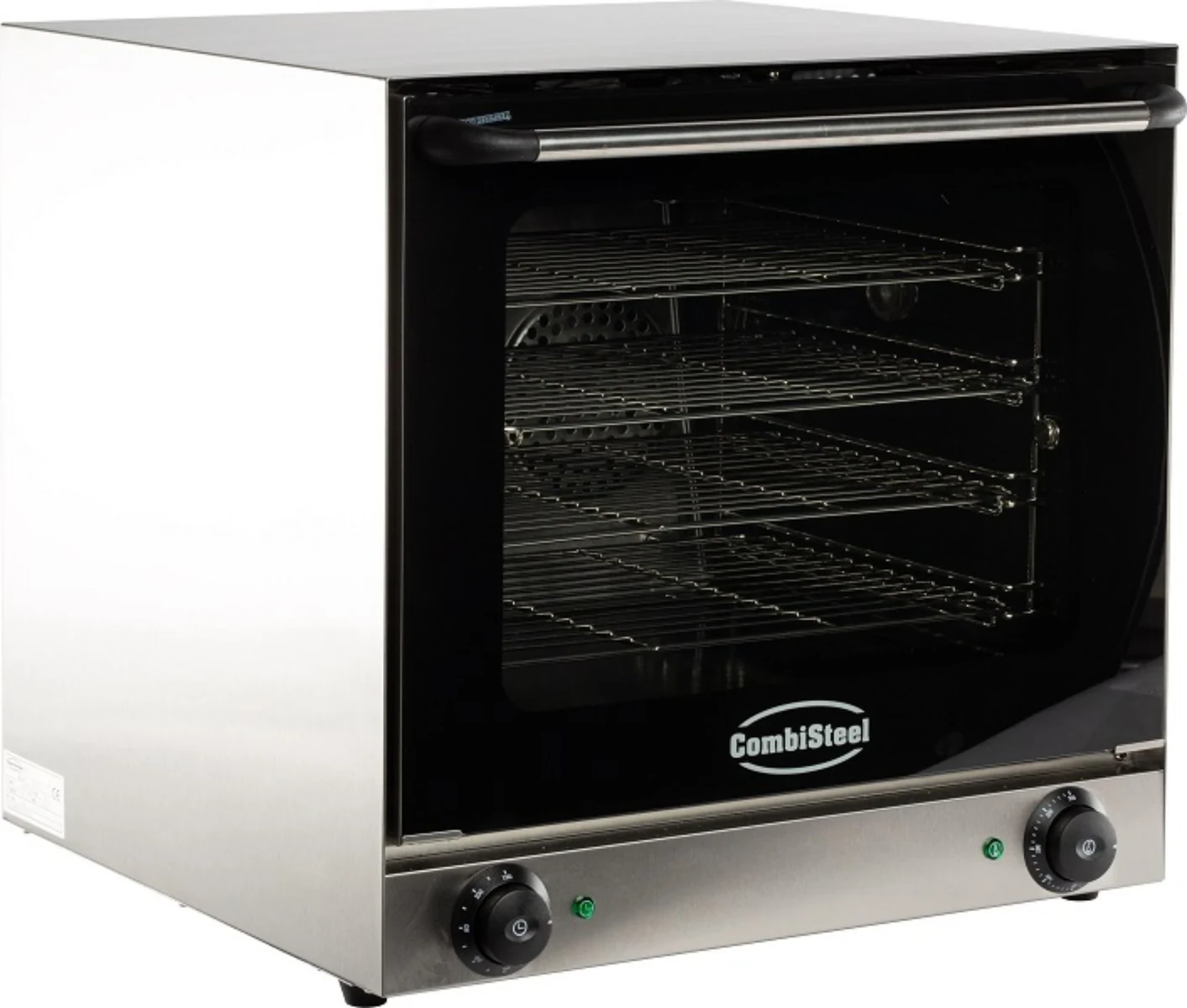
Compact convection is a sensible default for cafés, hotel breakfast service, deli counters, and smaller restaurant passes. It works best when you are rotating different foods through the oven: bake-off, roasting, reheating, and quick-turnaround items.
Go this way if you need flexibility without letting one product dictate the whole line. If mornings are pastries, lunch is wedges and wings, and evening is portioned bakes, convection suits that change in rhythm.
Deck pizza ovens (pizza-led service and batch loading)
A deck pizza oven earns its space when pizza is central and you want control over bake and consistency across a rush. It suits dough-led service where you are loading directly onto the deck and your team is comfortable managing timing, turning, and deck space.
Decks also suit Irish takeaway and casual dining patterns where orders come in waves. If your peak is a sharp 30 to 45 minutes, the question is whether planned batch loads clear the backlog, or whether you need a more continuous flow.
Conveyor ovens (continuous output and lower operator load)
A conveyor oven is built for a steady feed. It suits high-volume pizza, late bars with constant food orders, and event-style service where you want repeatable output without someone watching each bake stage.
The trade-off is operational. Conveyors reward tight prep discipline and a clear decision on what goes through the belt during peak. If it becomes the queue for pizza plus sides plus “throw that in as well”, throughput is the first thing to suffer.
A practical way to decide in under a minute
Use this as a quick filter before you get into tray sizes, usable levels, and pizza rates:
- If you cook lots of different items across the day and the top seller changes by daypart, start with compact convection.
- If pizza quality and bake control are the priority, start with a deck.
- If the problem is clearing tickets at a predictable rate for long stretches, start with a conveyor.
- If your peak is short and spiky, favour batch-friendly loading (often deck or convection).
- If your peak is long and steady, favour continuous flow (often conveyor).
If you want the oven choice to line up cleanly with dough, topping and pass, the workflow in this pizzeria work line planning guide is a good sanity-check so you are not sizing the oven in isolation.
Specs snapshot: trays/grids, usable positions, and pizza output (verified)
This is the hard-limit stuff. If these numbers do not suit your operation, no amount of “capacity” talk will fix it.
Compact convection: what physically fits
- CombiSteel 7500.0005 (EC1): 435 × 315 mm grids (W × D), 4 grids (Caterboss product listing).
- CombiSteel 7543.0017: 430 × 325 mm trays, 4 guide pairs, 3 aluminium trays supplied (technical data sheet).
Two practical implications:
- These two compact formats are close in size but not the same. Unless CombiSteel confirms cross-compatibility, treat them as different tray systems. “Nearly fits” usually ends in scraped trays, jammed guides, and poor airflow.
- Guide pairs are not the same as trays in the box. On 7543.0017 you have four usable levels, but if you only have the three supplied trays, your day-to-day batch size is three trays until you add another.
Pizza ovens: space limit vs throughput rate
- CombiSteel 7485.0020 (single deck): 9 pizzas at Ø30 cm at the same time (Caterboss product listing).
- CombiSteel 7485.0150 (conveyor): published throughput rates of 30 pizzas/hour at 25 cm, 15 pizzas/hour at 32 cm, 13 pizzas/hour at 40 cm (technical data sheet).
Read those numbers differently:
- “9 pizzas at once” is a deck space limit. It tells you how many orders can be in bake at the same time.
- “Pizzas/hour” is a planning rate that assumes a steady feed. If dough, topping, or boxing is stop-start, the oven will be waiting.
Tray/grid size and number of positions: what it means on the floor
Tray format is not just a spec. It drives what you can standardise, how you label and separate allergens, and how many spare trays you need so service does not stall when the wash-up is behind.
A few checks that save hassle:
- Count your trays, not your guide pairs. If the oven has four levels but you own three trays, you are running three-tray batches. That is fine, but plan around it.
- Think about landing space. Compact ovens encourage frequent loading and unloading. If you do not have a clear landing area for hot trays, the pass clogs quickly.
- Avoid portion maths without a test run. Portion yield depends on spacing, airflow needs, and how much colour you will accept under pressure.
Real-world pizza capacity: wave service vs steady flow
Deck oven (7485.0020): what “9 pizzas at once” really tells you
Treat 9 pizzas at Ø30 cm as the maximum deck real estate at that diameter. In service, the usable count is often lower if:
- toppings are heavy and need more bake time
- you are running thicker bases
- you want working space for turning and colour control instead of loading edge-to-edge
The operational question it answers is simple: how many pizza orders can be in bake at once before the pass starts waiting?
Conveyor oven (7485.0150): use the rate that matches what you actually sell
The published pizzas/hour rates are useful for staffing and dispatch planning because they are tied to diameter. They are also easy to misuse.
Plan around the diameter you sell most often. If 32 cm is your core size, that is the rate you should sanity-check against dough production, topping speed, and your cut/box station.
Worked example: batch scheduling (hypothetical)
This is deliberately simple. It is not a promise of cooking performance. It is a way to force your plan into physical loads so you can see whether the oven format suits your service.
1) Turn 120 portions into tray loads
- Example input: 120 portions
- Example assumption: 12 portions per tray
- 120 ÷ 12 = 10 tray loads
2) Pick a realistic batch size you can actually rotate
If you are working with an oven where only three trays are in daily rotation, a sensible plan is 3 trays per batch.
With 10 tray loads, that gives 4 batches:
- 3 + 3 + 3 + 1
This is exactly where “usable levels” and “what you own” diverge. If you want four-tray batches, you need four trays in rotation and the landing space to handle them.
3) Map the batches across a 90-minute service window
With 4 batches inside 90 minutes, the average window is 22.5 minutes (90 ÷ 4). In practice, treat these as dispatch windows rather than exact cook times.
Swipe or scroll horizontally to see all table columns.
| Batch | Tray loads in batch | Portions (12 per tray) | Target dispatch window (within 90 mins) | Operational note |
|---|---|---|---|---|
| 1 | 3 | 36 | Minutes 0 to 20 | Start with fast sellers so the pass moves early. |
| 2 | 3 | 36 | Minutes 20 to 45 | Expect more door openings as checks and replating happen. |
| 3 | 3 | 36 | Minutes 45 to 70 | Keep breathing room for remakes and dietary variants. |
| 4 | 1 | 12 | Minutes 70 to 90 | Use as catch-up, not the core production run. |
4) Add the checks that usually break a paper schedule
Before you rely on any schedule, stress-test the weak points that show up in real kitchens: prep finishing late, product going in colder than expected, doors being opened “for a quick look”, and not enough space for resting or hot holding.
If you are operating under HACCP, allow time for temperature checks and corrective actions. That is labour and minutes you need to plan for.
Comparison of bakery trays vs compact grids (workflow choice)
This section is about how you want the kitchen to run, not a claim about a specific CombiSteel 600 × 400 oven in this guide.
A 600 × 400 bakery-tray setup is a common industry approach when you want a repeatable bakehouse rhythm: the same trays moving through prep, racking, bake-off, cooling and storage.
A compact grid/tray setup is usually chosen for tight kitchens and mixed service, where smaller loads and faster turnaround matter more than full-sheet batching.
Neither is “better” in general. The cost and hassle often sits in duplicated trays, racks and storage as much as it does in the oven itself. If you want to standardise tray formats across the kitchen, the GN and bakery tray sizes guide is the right place to check footprints and compatibility.
Next step: sanity-check your service profile against a spec sheet
Take your tray format or pizza diameter and your peak-hour ticket pattern, then test it against the verified limits above.
If you are pizza-led, use the conveyor’s diameter-based rate as a planning input, then sanity-check it against the part of your line that usually slows first: dough, topping, or cut/box/dispatch. For reference, use the manufacturer data for 7485.0150 here: 7485.0150 technical sheet · PDF