
Neutral equipment · CombiSteel Knowledge Hub
Can a CombiSteel Worktable Support an Oven or Mixer? Shelf vs Worktop Ratings
Understand if your CombiSteel worktable can support ovens or mixers in Irish commercial kitchens.
In this guide
If you put an oven or mixer on a stainless worktable, you are turning a prep bench into an equipment stand. The common mistake is reading a published load figure and assuming it applies to the worktop, when it may only apply to the shelf.
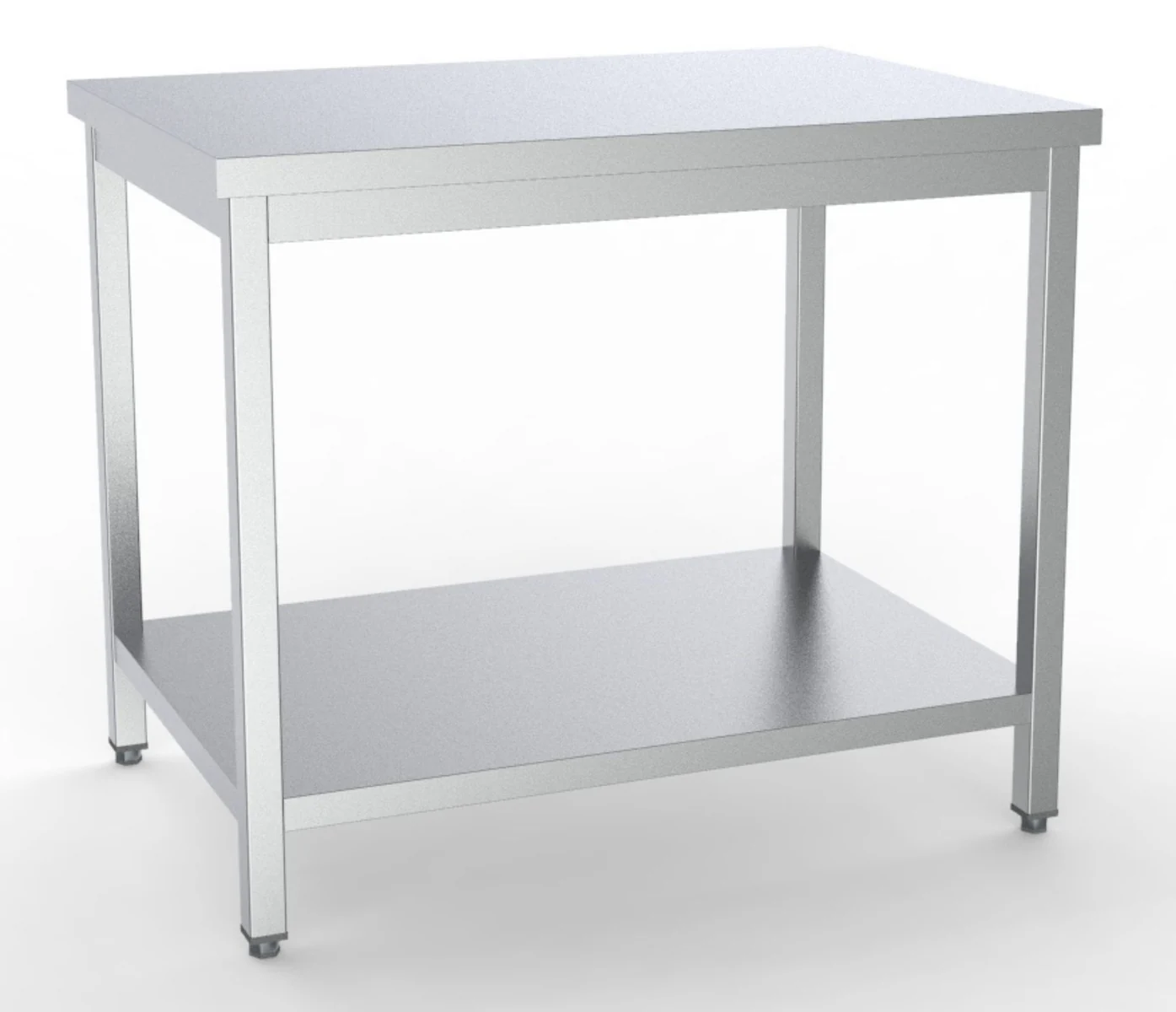
For CombiSteel worktable 7333.0063, the manufacturer technical data sheet states “Max. load capacity shelf (kg) 300”. It does not declare any maximum load for the worktop (CombiSteel technical data sheet for 7333.0063). In practical terms, treat the worktop load limit as unknown until you have it confirmed for that exact model.
Below is a clean way to document what you know, what you do not, and what to measure on site, using the CombiSteel 7534.0010 planetary mixer as the appliance example.
What the CombiSteel documents actually say (and what they do not)
Worktable 7333.0063: shelf rating is declared, worktop rating is not
- Declared rating (undershelf only): the data sheet states “Max. load capacity shelf (kg) 300” (7333.0063 technical data sheet).
- Worktop load limit: not stated in the same document, so you cannot treat the top as approved for heavy or vibrating appliances by default.
- Footprint for layout checks: 900 × 600 × 850 mm (W × D × H) per the Caterboss listing.
In an Irish kitchen fit-out, the shelf number is useful for storage planning. It is not enough, on its own, to sign off a mixer stand.
Mixer 7534.0010: process limits are declared, bench suitability is not
The CombiSteel manual for models 7534.0005–7534.0020 includes a capacity row for 7534.0010:
- Bowl: 20 L
- Maximum kneading capacity: 7.5 kg
- Maximum flour capacity: 5 kg
- Power: 1 kW
- Electrical: 230 V, 50/60 Hz
Source: CombiSteel mixer manual, capacity table
Those figures help you plan batches. They do not tell you what bench is suitable underneath the machine.
If you are tempted to plan by “litres = kilograms”, don’t. The same table shows different ratios across the 10 L, 20 L, 30 L and 40 L versions, so a simple rule of thumb will mislead you (manual capacity table). For batch planning, keep it strict to the published flour and kneading limits, and use this guide for the reasoning: bowl litres vs flour and dough capacity.
What changes when a bench becomes an equipment stand
Even if an appliance “fits”, the loads it puts into a table are different from normal prep.
- Point loads: appliances often load through a small number of feet, concentrating force into a few spots on the worktop.
- Dynamic loads: a planetary mixer’s load moves during use. The manual labels the unit a “Planetery Mixer” (manual front matter).
- Service reality: staff leaning, knocking the bench, or shifting equipment for cleaning is where borderline setups show up.
The key point is simple: if the worktop rating is not declared, you cannot complete a proper suitability check from paperwork alone.
Appliance support brief (copy/paste)
Use this as a short record for your fit-out file or HACCP equipment folder. It keeps the decision auditable.
Support surface
- Worktable model: CombiSteel 7333.0063
- Worktop size (for layout): 900 × 600 mm
- Height: 850 mm
- Declared load rating in manufacturer sheet: “Max. load capacity shelf (kg) 300” (undershelf only) (technical data sheet)
- Declared worktop load rating: not stated in supplied manufacturer sheet (technical data sheet)
Appliance being considered
- Appliance model: CombiSteel 7534.0010 planetary mixer
- Published limits (for production planning): 20 L bowl, max kneading 7.5 kg, max flour 5 kg, 1 kW, 230 V, 50/60 Hz (manual capacity table)
- Control note relevant to use: “ALL models have 10 variable speeds under each agitator.” (manual)
On-site measurements to record (do not guess)
- Appliance base width (mm): ____
- Appliance base depth (mm): ____
- Foot positions from left/right edges (mm): __ / __
- Foot positions from front/back edges (mm): __ / __
- Any fixed protrusions affecting placement (rear cable exit, guards, etc.): ____
Site risk checks (practical, not manufacturer ratings) These are common sense checks to avoid an avoidable wobble or tip risk. They are not stated CombiSteel installation criteria for either model.
- Is the appliance fully supported on the worktop with no obvious edge overhang? Yes / No
- Do all feet sit flat on a levelled table (no rocking)? Yes / No
- In normal operation, does the machine stay where it is placed? Yes / No
Power isolation (manual requirement to plan for) The mixer manual states:
“Always disconnect or unplug power before cleaning, servicing or adjusting parts or accessories.”
Source: CombiSteel manual safety instruction
Record how you will meet that instruction on your site:
- Isolation method used: plug / isolator / other: ____
- Can staff access it in the normal position of the mixer? Yes / No
Decision
- If the worktop load rating remains unknown, record: Not approved as an equipment stand until confirmed.
Simple footprint diagram to fill in on site (top view)
Worktop: 900 mm (W) x 600 mm (D)

Back
┌──────────────────────────────────────────────┐
│                                              │
│   Appliance base width: ______ mm            │
│   Appliance base depth: ______ mm            │
│                                              │
│   ○ (foot)                    ○ (foot)      │
│                                              │
│                                              │
│   ○ (foot)                    ○ (foot)      │
│                                              │
└──────────────────────────────────────────────┘
Front

Record edge clearances:
Left: ___ mm  Right: ___ mm  Front: ___ mm  Back: ___ mm
Practical checks (what you can do without inventing specs)
1) Get the worktop rating, or treat the answer as “not approved”
For 7333.0063, the supplied manufacturer sheet only gives a shelf rating and does not declare a worktop rating (technical data sheet).
If you cannot get a model-specific worktop limit in writing, the commercially sensible approach is to spec a dedicated stand or a table explicitly rated for equipment loads.
If you are still choosing the right bench format for the job (shelf, underbench storage, landing space), this guide is the better starting point: choosing neutral kitchen equipment for the job.
2) Measure base, feet and edge clearances on site
The mixer capacity table gives process limits, but it does not include external dimensions or weight in that section (manual capacity table). If you cannot find dimensions elsewhere in the manual or a separate spec sheet for your exact model, measure on site and record it.
You are looking for a stable setup with:
- enough top area under the full base,
- feet positioned sensibly inboard,
- and working space around the unit so staff are not forced to drag it across the bench during service.
3) Mixer use and attachments affect how hard it works the bench
The manual’s attachment guidance is a useful proxy for lighter vs heavier work:
- Hook: doughs including heavy bread dough and pizza dough
- Flat beater: batters, mash, icing, etc.
- Wire whip: light whipping work
Source: CombiSteel manual, agitator recommendations
Heavier dough work is where instability tends to show up first.
4) Plan power isolation so staff can comply with the manual
Don’t leave isolation as an afterthought. If the plug or isolator is awkward to reach, staff will work around it in a rush, and that is when incidents happen.
The only requirement we can state from the supplied manufacturer evidence is the manual instruction to disconnect/unplug before cleaning, servicing, or adjusting accessories (quoted above).
Hypothetical arithmetic example (method only, not an approval)
Sometimes you need a quick illustration of how to total a static load, before you even get into point loads and movement.
- Hypothetical empty appliance mass: 56 kg
- Hypothetical contents (bowl plus ingredients): 6 kg
- Hypothetical static total: 62 kg
This is not a claim about the 7534.0010’s actual weight, and it is not approval to mount any mixer on worktable 7333.0063. The worktop rating for 7333.0063 is not declared in the supplied manufacturer sheet, and dynamic loads and point loads can be more important than the static number.
Next step: check the documents before you sign off the install
For 7333.0063, start with the manufacturer sheet and confirm whether a worktop rating exists for your intended use. For the mixer example referenced here, the product listing is: CombiSteel planetary mixer 20L (model 7534.0010).