
Cooking · CombiSteel Knowledge Hub
CombiSteel Smooth vs Ribbed Griddle Plate: Choose 7518.0140 or 7518.0145 for Your Menu
Choosing between CombiSteel 7518.0140 (smooth) and 7518.0145 (ribbed) comes down to what you cook and how you clean. Use this guide to match the plate surface to your menu, workflow, and close-down routine.
In this guide
You are choosing between two like-for-like CombiSteel countertop electric fry tops: 7518.0140 (smooth) and 7518.0145 (ribbed).
CombiSteel lists them as the same electrical platform and body size, with the plate surface as the key difference: 220–240 V, 2 kW, 360 × 450 × 220 mm. Source: page 5 of the CombiSteel user manual for 7518.0140 and 7518.0145.
So your decision is mainly about finish on the plate (full contact vs ridges), grease and juices, and how much clean-down time you can protect during service and at close.
Introduction to CombiSteel griddle plates
A CombiSteel griddle plate (often listed as a fry top) is a compact countertop electric cooking surface for fast searing and frying during service.
With this pair, there is no point over-analysing power or footprint. Choose the surface that suits what you actually sell and how your team works the station.
Comparing smooth and ribbed griddle plates
The two like-for-like CombiSteel models
- 7518.0140 (smooth)
- 7518.0145 (ribbed)
CombiSteel shows both models side by side with the same supply, power and dimensions in the user manual (page 5): 7518.0140/7518.0145 user manual.
The ribbed surface for 7518.0145 is also stated in the technical data sheet (page 2): CombiSteel 7518.0145 technical data sheet.
Quick comparison (what changes in use)
Swipe or scroll horizontally to see all table columns.
| Comparison point | 7518.0140 Smooth | 7518.0145 Ribbed | What it means in service |
|---|---|---|---|
| Plate surface | Smooth (user manual, p.5) | Ribbed (user manual, p.5; also “Griddle surface: Ribbed” in tech sheet, p.2) | Smooth gives full contact and easier spatula work. Ribbed gives grill lines and less contact, but you will spend longer on the grooves. |
| Electrical supply | 220–240 V (user manual, p.5) | 220–240 V (user manual, p.5) | No advantage either way on utilities. |
| Power rating | 2 kW (user manual, p.5) | 2 kW (user manual, p.5) | Don’t expect one to be “more powerful”. Output is mainly down to product load, moisture, and how clean the surface stays. |
| Dimensions | 360 × 450 × 220 mm (user manual, p.5) | 360 × 450 × 220 mm (user manual, p.5) | Same counter planning. Pick based on cooking result and cleaning time. |
Cooking applications and menu suitability
The surface choice shows up fastest at peak: sticking, turning speed, mess on the plate, and how often the cook has to stop to sort the surface.
Choose smooth (7518.0140) if your day is mostly full-contact cooking
Smooth is usually the safer option when you need consistent colour and clean release, and you’re doing a lot of spatula work.
Typical smooth-plate jobs:
- Eggs (fried or scrambled), pancakes, French toast
- Rashers, sausages, black and white pudding
- Mushrooms and tomatoes
- Toasted wraps and flatbreads where you want even contact
- Smash-style burgers where you need to press, turn and scrape cleanly
Choose ribbed (7518.0145) if grill lines are part of what you’re selling
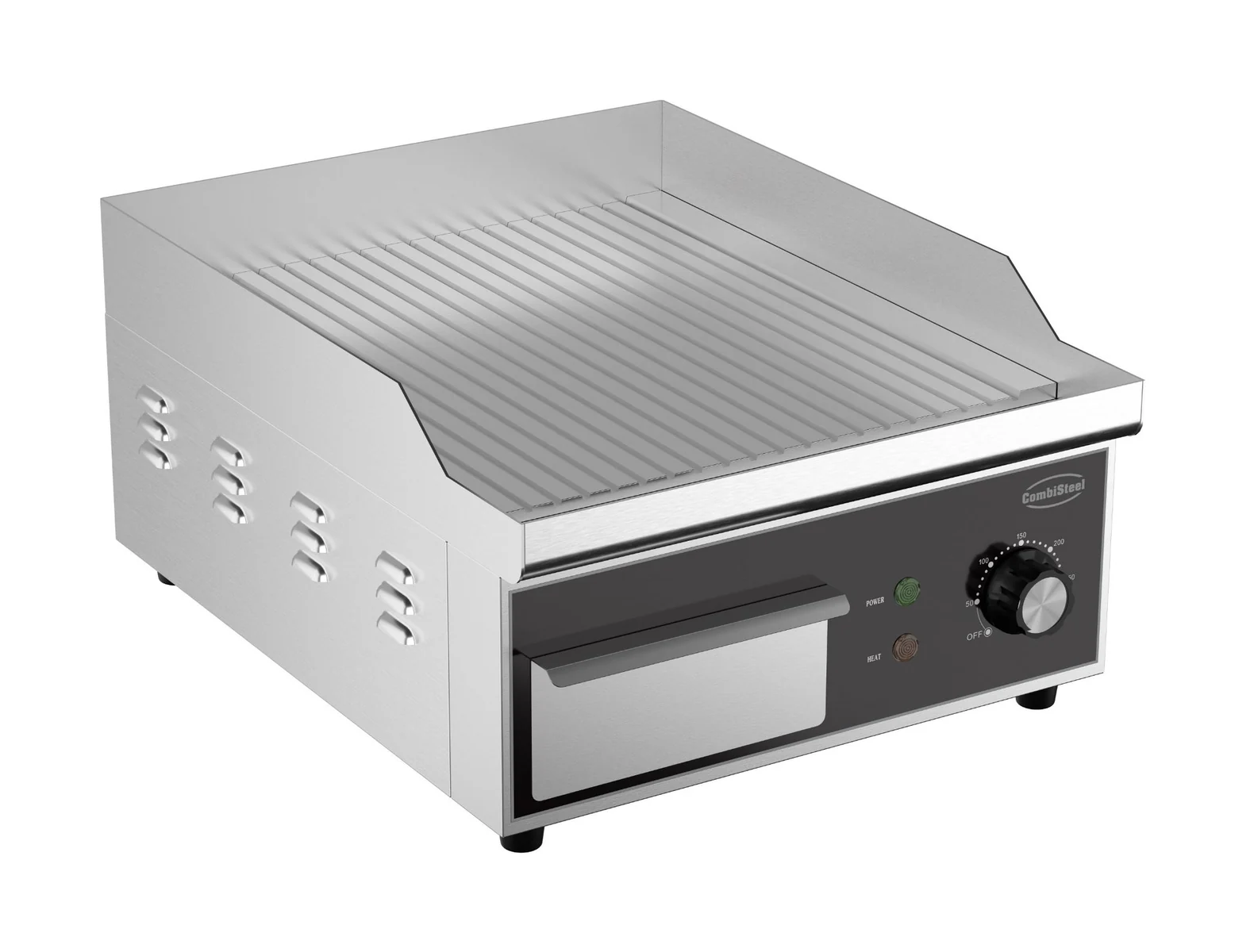
A ribbed plate earns its keep when presentation depends on bar marks, or when you want less full contact so product is not sitting entirely in its own juices. CombiSteel lists 7518.0145 as ribbed in the 7518.0145 technical data sheet.
Ribbed tends to suit:
- Chicken fillets, steaks, halloumi
- Kebab-style items laid across the ridges
- Veg where grill lines lift the look (especially for takeaway)
The trade-off is residue management. Marinades and glazes can carbonise in the channels. If you cannot stay on top of that, smoke and off flavours become your limiting factor.
A simple “portions-per-batch” trial you can run on your own menu (hypothetical)
Because the units are like-for-like apart from the surface, a practical way to choose is to test how many portions you can cook per batch without losing control.
Hypothetical template (not a performance claim for either model):
- Set a trial of 6 portions per batch (for example, 6 burgers or 6 chicken fillets)
- Run 3 batches across a 24-minute window if your cook-and-turn cycle averages 8 minutes
- That gives 18 portions in that window for that product
Repeat using your real portion size, oiling routine, and tools. Note what forces you to slow down: crowding, excess liquid, awkward turning, or needing to stop and clear build-up.
Quick decision cues (useful when you only have one plate)
- Breakfast-heavy, lots of eggs and soft items: go smooth.
- Grill-mark presentation is non-negotiable: go ribbed.
- You run sticky marinades regularly: lean smooth, unless you have disciplined groove cleaning during service.
- Staffing is tight at close: lean smooth. Ribbed is manageable, but it rarely cleans itself.
Cleaning and maintenance considerations (follow the manual)
The manual is clear on the basics:
- Clean only after the machine is cold. Source: user manual, p.3.
- Disconnect the appliance before cleaning or maintenance. Source: user manual, p.5.
- Do not use sharp metal, and do not clean with water. Source: user manual, p.5.
- Do not use a water jet or immerse the appliance (or any part of it). Source: user manual, p.5.
That rules out a few common kitchen habits. Build the station routine around the manufacturer’s cleaning limits, and train staff so nobody reaches for the nearest jug or steel scraper when service is manic.
What changes between smooth and ribbed at clean-down
- Smooth: faster to wipe because the whole surface is accessible.
- Ribbed: slower, because residue sits in the grooves and needs more passes to lift.
If you are updating heat and grease control as part of this decision, this guide will help you write a proper brief for your contractor: Plan your kitchen extraction.
Menu flexibility with CombiSteel griddles
If your menu swings between breakfast and lunch, the simplest way to avoid grief is to pick the surface that matches your dominant work.
- If the plate is mainly a breakfast engine, a ribbed surface often adds friction (literal and operational).
- If your plates and photos rely on bar marks, smooth can leave you fighting presentation all day.
In small Irish kitchens, the cost is rarely the unit. It’s the minutes lost when the docket rail fills up, the surface is messy, and you’re remaking product to get it looking right.
If you are planning how a griddle fits alongside fryers, bains, salamanders and prep space, read this next: Plan your commercial cooking line.
FAQs
Can I use a ribbed plate for tasks usually done on a smooth plate, like pancakes or eggs?
You can, but it’s usually a compromise.
Eggs and batters benefit from full contact for even colour and clean release. On a ribbed plate, mix can flow into the channels and set there, which tends to slow you down and adds to clean-down.
Does a ribbed griddle plate require more ventilation than a smooth plate?
Not automatically.
These two models are listed at the same connected load in CombiSteel documentation, so ventilation planning should be driven mainly by what you cook, your peak volume, and how clean the surface stays.
If you are cooking fatty meats or sugary marinades, a ribbed plate can show more visible smoke in real use as residue builds in the grooves.
Would a half smooth, half ribbed plate offer any advantage in a busy kitchen?
It can, if you regularly run two distinct jobs at once (for example, eggs and wraps on the flat side, chicken fillets on the ribbed side).
The trade-offs are less usable space per job and a fussier clean at close. If one style dominates your sales, a single-surface plate that matches that dominant job is usually easier to run.
Next step: check the current model listings
If you are shortlisting, it helps to look at the live listings and confirm you are still comparing like-for-like:
- CombiSteel 7518.0140 electric smooth fry top (2 kW)
- CombiSteel 7518.0145 electric ribbed fry top (2 kW)
When you’re checking listings, confirm:
- Model number matches your spec (7518.0140 vs 7518.0145)
- Surface type is stated correctly (smooth vs ribbed)
- Electrical supply and rating align with the manufacturer specs
- Dimensions align with the manufacturer specs
Use the manufacturer table in the 7518.0140/7518.0145 user manual (p.5) as your reference point for the like-for-like comparison.