
Cooking · CombiSteel Knowledge Hub
Single or Twin-Tank CombiSteel Fryer? Choosing Between 7455.1000 and 7455.1005
Choose the right CombiSteel countertop fryer for your kitchen. Compare 7455.1000 vs 7455.1005 for workflow, separation, and electrical planning, using verified Irish supplier specs.
In this guide
You’re choosing between a single-tank CombiSteel 7455.1000 and a twin-tank 7455.1005 based on service flow and separation, not litres alone.
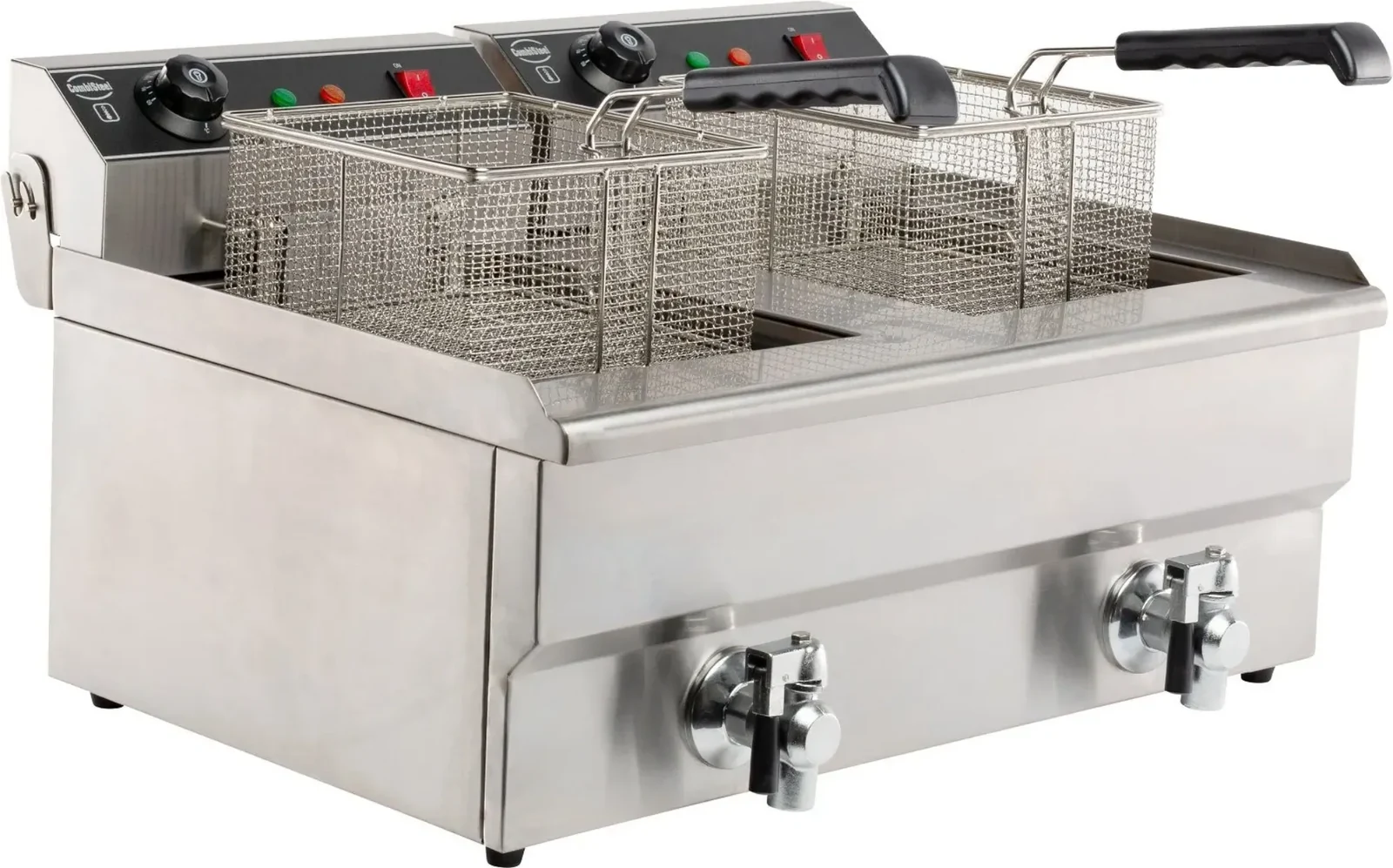
A single tank means one basket cycle and one oil bath. A twin tank gives you two separate frypots and two baskets, so you can run two jobs in parallel or keep products apart. The trade-off is more daily discipline, more cleaning and oil management, and a proper electrical check before it lands on the counter.
CombiSteel 7455.1000 vs 7455.1005 (what you’re really buying)
Both are countertop fryers, but they suit different types of service.
Important: the supplier spec field is “Contents frypot (Ltr)”. That’s useful for comparing tank size, but it is not a manufacturer-rated food load, throughput figure, or portions-per-hour claim for these exact models.
At-a-glance comparison (verified spec points + operational impact)
Swipe or scroll horizontally to see all table columns.
| What changes in a working kitchen | 7455.1000 (single tank) | 7455.1005 (twin tank) |
|---|---|---|
| Frypots and baskets (as listed) | Contents frypot: 1 × 8 L, 1 basket (Caterboss listing) | Contents frypot: 2 × 8 L, 2 baskets (Caterboss listing) |
| Electrical input (as listed) | Electrical power: 3.3 kW at 230 V | Electrical power: 2 × 3.3 kW |
| Rush-hour flow | One queue. Everything waits its turn. | Two queues. You can run two basket cycles in parallel if the station is set up for it. |
| Product separation | Limited. One oil bath takes the hit for everything. | Better separation options because there are two separate frypots, but it still depends on staff habits. |
| Cleaning and oil routine | One tank to manage. | Two tanks to manage. You can protect one side from heavy crumb, but there’s more end-of-day work. |
Choosing based on your menu and ticket peaks
When the 7455.1000 usually makes sense
Go single-tank if:
- your fried menu is narrow and most items can share the same frypot without quality dropping off,
- your peak demand is steady rather than spiky,
- you want the simplest routine for staff.
The constraint is predictable: one basket becomes the choke point when mixed orders stack up.
When the 7455.1005 earns its keep
Go twin-tank if:
- you regularly need two fryer “lanes” at the same time (different products, different drop patterns, or simply avoiding one queue),
- you want to keep certain products apart so one doesn’t drag down the other’s condition,
- you can support the extra electrical demand and the extra cleaning and oil routine.
Twin tanks only help if you run them like two separate fryers, not one shared station.
A practical sizing worksheet (plus a worked, hypothetical example)
Because the supplied sources don’t give a verified output-per-hour or maximum basket load for these models, the cleanest way to decide is to map your own service and batch routine.
Use this with your SOPs and your actual peak hour:
Swipe or scroll horizontally to see all table columns.
| Product line | Peak portions per hour (your POS) | Your drop time (your SOP) | Your basket fill rule (your SOP) | Do you need it running in parallel with another product? (Yes/No) | Notes (crumb load, dietary separation, holding limits) |
|---|---|---|---|---|---|
| Chips | |||||
| Breaded/battered item | |||||
| “Clean” item (veg, halloumi, etc.) |
How to read it:
- If you keep writing “Yes” in the parallel column, you’re describing a two-lane need, which points toward the 7455.1005.
- If your peaks are manageable with one predictable queue, the 7455.1000 is often the better operational fit.
Worked example (hypothetical, not a manufacturer claim):
- You plan for 10 batches in a rush period.
- Your kitchen standard is 3 portions per batch.
- Your average cycle is 6 minutes per basket.
On a single basket, that’s 10 cycles × 6 minutes = 60 minutes of sequential basket time to produce 30 portions.
With two independent baskets, you can run two cycles at once in principle. In practice, the result depends on staffing, whether drops finish together, and whether one product keeps interrupting the other.
If you’re redesigning the line rather than swapping one unit, map the fryer against the rest of the hot line using planning a commercial cooking line.
Electrical and installation checks (don’t leave this to the last minute)
The listings confirm the headline electrical loads in the table above, but they don’t confirm the connection arrangement.
Before you order or book an install date:
- Confirm the connection details on the delivered unit using the data plate and supplied documentation.
- Plan for how you’ll actually run it. If you expect to run both tanks during peak, treat the twin-tank unit as a genuine step up in demand when you’re checking circuit capacity, protective devices and isolation.
- Bring it into your extraction plan early. A fryer adds heat and grease-laden vapour. Get the location and duty cycle into your canopy and cleaning plan using the commercial kitchen extraction planning guide.
For operating and safety instructions, use the manual and documentation supplied with the unit and the unit’s data plate.
Allergens and dietary separation (useful, but not a guarantee)
Two separate frypots can reduce cross-contact through shared oil, which is often the day-to-day issue with a single-tank fryer.
What twin tanks do not do on their own:
- They do not guarantee allergen safety.
- They do not replace controls for prep, utensils, draining/holding or staff habits.
If you’re relying on separation for gluten-free, vegan/vegetarian, or a known allergen product, keep it operational: decide which tank is for what, which basket stays with it, and what your own validated procedure is if they get mixed.
Final recommendation (keep it commercial)
- Choose the CombiSteel 7455.1000 if you want a straightforward, single-queue fryer and you’re confident it won’t become the bottleneck at peak.
- Choose the CombiSteel 7455.1005 if your peak service genuinely needs two parallel fryer jobs and you can support the extra electrical demand and the added cleaning and oil routine.
Sources (product pages):
- 7455.1000: CaterBoss electric countertop fryer 1x8 litre specifications
- 7455.1005: CaterBoss twin tank electric countertop fryer 2x8 litre specifications