
Refrigeration · CombiSteel Knowledge Hub
CombiSteel Refrigerated Counters: Should Your Prep Station Use Drawers or Doors?
Compare CombiSteel refrigerated counters with drawers vs. doors to optimise prep station access and organisation.
In this guide
You choose a refrigerated counter to keep ingredients within arm’s reach on the prep line. The doors vs drawers layout is what decides how fast, tidy, and repeatable the station feels when service is under pressure.
This guide compares three CombiSteel options:
- 7950.0430: 2 self-closing doors
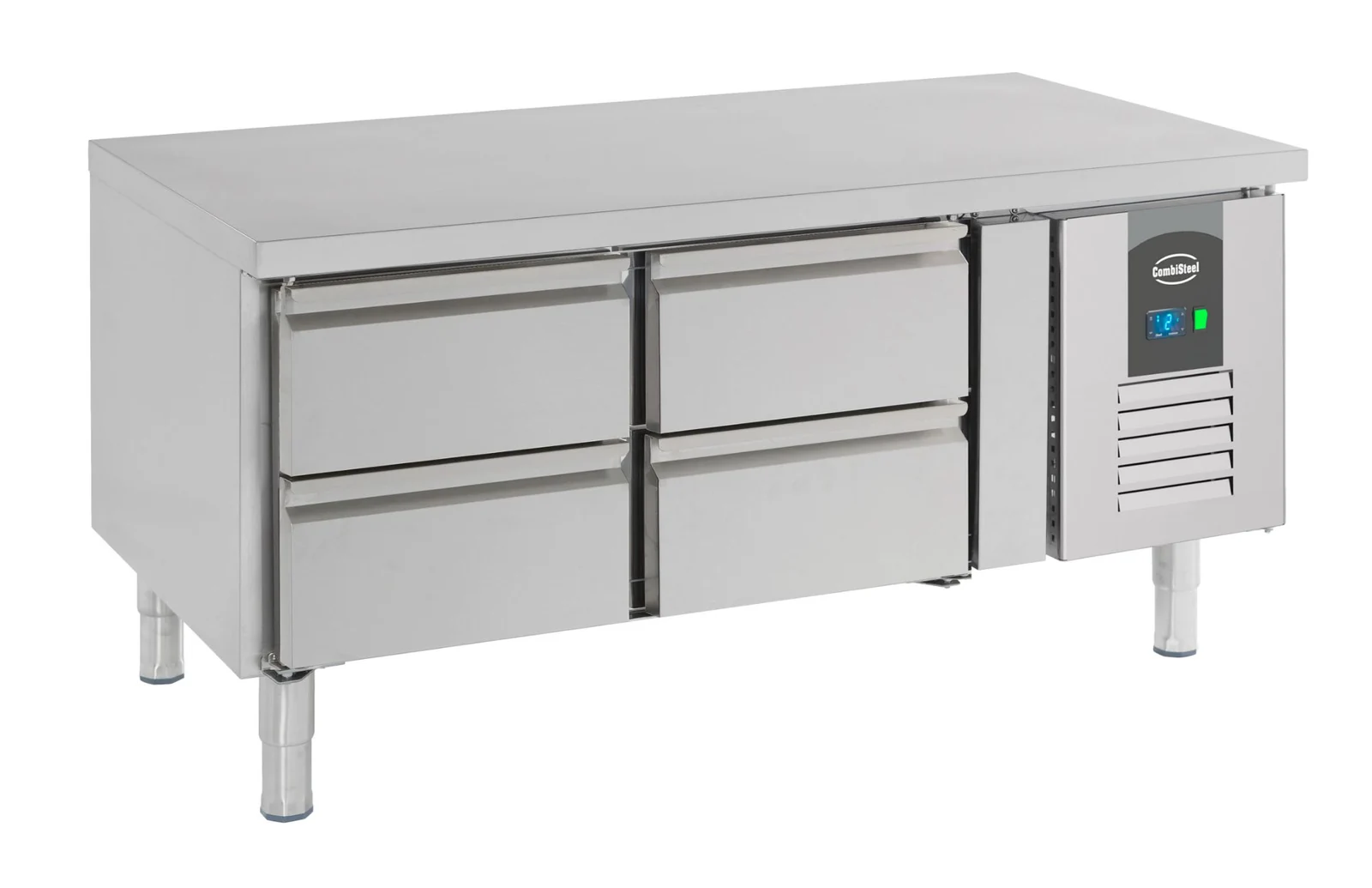
- 7950.0445: 4 self-closing drawers
- 7489.5520 (Counter 700): 2 doors + 2 drawers, listed as GN 1/1
Two of these (7950.0430 and 7950.0445) are genuinely like-for-like on the basics: both are listed at 1200 x 700 x 650 mm with 202 L gross / 168 L net capacity in their technical data sheets (7950.0430, 7950.0445). So your decision is mainly about access and organisation, not litres.
What a refrigerated counter is doing on a prep line
A refrigerated counter is there to keep chilled ingredients close to the action. Done well, it reduces walking, keeps food out of ambient for less time, and makes it easier to run a consistent reset and labelling routine between rushes.
The access format matters because it changes what staff actually do when they are in and out of the unit all day.
Model overview (verified specs)
Swipe or scroll horizontally to see all table columns.
| Model | Layout | External size (W x D x H) | Capacity (as stated in supplied sources) | Notes |
|---|---|---|---|---|
| CombiSteel 7950.0430 | 2 self-closing doors | 1200 x 700 x 650 mm | 202 L gross / 168 L net | Like-for-like body vs 7950.0445; doors suit flexible shelf storage |
| CombiSteel 7950.0445 | 4 self-closing drawers | 1200 x 700 x 650 mm | 202 L gross / 168 L net | Same stated body and volume as 7950.0430; drawers suit zoned mise en place |
| CombiSteel 7489.5520 | 2 doors + 2 drawers | 1865 x 700 x 850 mm | 474 L gross (net not stated in supplied sources) | Counter-height format; listed as GN 1/1 |
Doors vs drawers: what changes in real service
With the 7950-series, the capacity and footprint are the same on paper. The practical difference is how product is reached, rotated, and put back when it’s busy.
Doors (example: 7950.0430)
Doors suit you when you want one larger chilled cavity you can reconfigure:
- Bulkier packs and taller containers that do not sit neatly in a drawer.
- Stock that changes week to week, where you want to adjust shelves rather than commit to fixed compartments.
- A shift-start loading routine where you load once, then open less often and take out more per open.
What to watch:
- Door cabinets can become “stacking and rummaging” if the station is under pressure.
- Items at the back are easy to forget, which makes date rotation harder unless the team stays disciplined.
Drawers (example: 7950.0445)
Drawers suit you when you want repeatable organisation and lots of quick opens:
- Portion-led prep where “one drawer, one job” is realistic (garnish, dairy, cooked meats, sauces).
- Stations where multiple staff need access without moving other people’s tubs to reach what they need.
- Faster visual checks on what’s low, which helps with mid-service top-ups.
What to watch:
- Drawers work best with a container plan. If container sizes and labelling are inconsistent, the drawer layout can feel restrictive.
- Odd-shaped packaging is often awkward in drawers, even when the litres look generous on paper.
Mixed doors and drawers (example: 7489.5520)
A mixed layout exists because many Irish kitchens need both storage styles on the one run:
- Use drawers for the high-grab mise en place that is opened constantly.
- Keep reserve stock, taller packs, or sealed prep behind doors.
It is also a different physical format. The 7489.5520 is listed at 1865 x 700 x 850 mm (counter height), while the 7950.0430 and 7950.0445 are 650 mm high bodies. Treat it as a layout and build decision, not a straight swap.
Container fit: what you can confirm from the supplied sources (and what you cannot)
If your prep system is built around gastronorm, the key point in the supplied evidence is simple:
- Only the CombiSteel 7489.5520 is explicitly listed as GN 1/1 on the product listing: 7489.5520.
- For 7950.0430 and 7950.0445, GN 1/1 compatibility is not confirmed in the verified facts provided here. Their data sheets confirm external size and gross/net capacity, but do not, in the supplied extracts, confirm internal GN sizing.
So for the 7950-series, plan container fit as a check you do before buying:
- Work from your actual containers (including lids and rims), not “700 mm deep” on the outside.
- Confirm the internal fit-out in the manufacturer documents before you standardise a line around GN.
If you need a refresher on footprints before you commit to a container system, use the GN and bakery tray sizes guide.
A quick workflow check that usually settles the decision
Ask: What is this counter doing between 12:30 and 14:30 on a Saturday?
- Constant small grabs on the line (sandwich, pizza, grill, deli, pastry assembly): drawers usually win because they support quick, predictable access.
- Bigger pulls, less often (batch prep tubs, sealed gastro trays for later, bulk packs): doors are often simpler because you have one open space to load and unload.
Then do a short paper check:
- List what must be in the counter during peak.
- Mark what must be separated for your routine (raw vs ready-to-eat, allergens, labelled prep tubs).
- Decide what needs to be segregated and visible (often drawers) versus what can be stacked and accessed less often (often doors).
Hypothetical example only: if you want 8 containers at hand, and you assume 2 containers per drawer, that suggests 4 drawers for that workflow. It is not a confirmed loading layout for any specific model. Usable space depends on the actual drawer/rail setup and the container depths you run.
Energy and temperature recovery: avoid guessing
There is no model-specific performance data in the supplied sources that proves a guaranteed energy or recovery advantage for doors versus drawers.
In practice, running cost is usually driven more by how often the unit is opened and how long it is left open during prep. Choose the layout your team will use quickly and consistently.
Selecting the right model for your site
Use the models here as a straightforward shortlist:
- Choose CombiSteel 7950.0430 if you want a like-for-like 1200 mm counter body with 2 self-closing doors and flexible internal space, listed at 202 L gross / 168 L net and 1200 x 700 x 650 mm (data sheet).
- Choose CombiSteel 7950.0445 if you want the same stated body and capacity, but prefer 4 self-closing drawers for zoning and repeatable organisation (data sheet).
- Consider CombiSteel 7489.5520 if you want a counter-height run and you specifically want mixed access and a unit listed as GN 1/1, with 2 doors + 2 drawers, 474 L gross, and 1865 x 700 x 850 mm.
If you want a broader checklist for choosing commercial refrigeration by layout, footprint, and day-to-day service realities, use Choose a commercial refrigerator.
Next step: shortlist the layout first
Pick your access format first (all doors, all drawers, or mixed), then confirm container fit and working height against your bench plan.