
Guides · CombiSteel Knowledge Hub
CombiSteel Oven Tray Capacity Guide for Menu Portions and Tray Loads (EC1 7500.0005 vs 7543.0020)
Plan CombiSteel oven output in trays and loads, not guesswork. Compare the EC1 7500.0005 and 7543.0020 humidifier model, and translate portions into realistic tray counts and shelf usage for Irish commercial kitchens.
In this guide
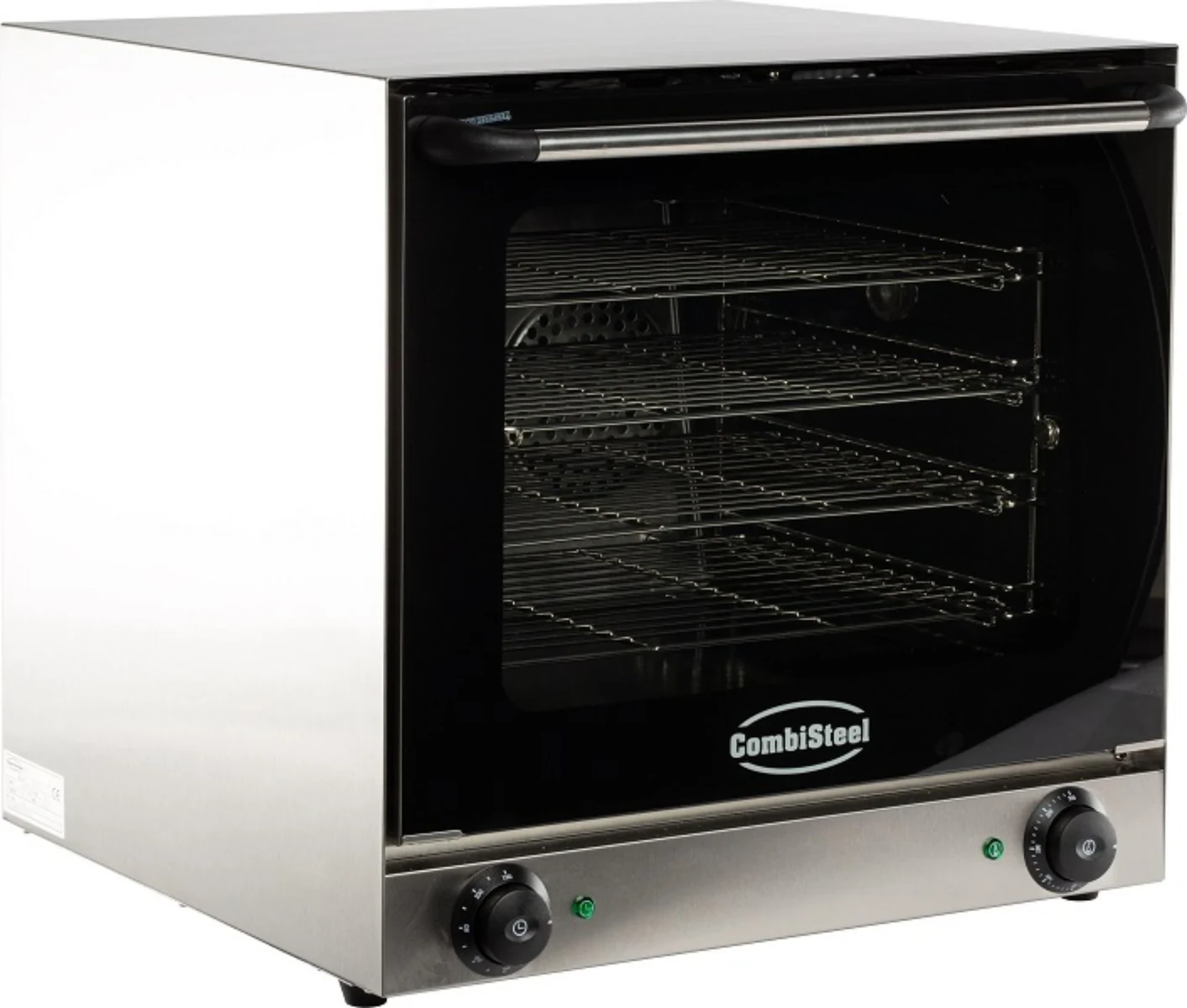
You plan ovens in trays and loads, not litres or “covers”. This guide shows how to turn projected portions for a service window into tray counts and realistic oven loads for two CombiSteel convection ovens:
- CombiSteel EC1 (SKU 7500.0005): 4 grid positions using 435 × 315 mm grids.
- CombiSteel convection oven with humidifier (SKU 7543.0020): 4 × GN 1/1 positions with 4 guide pairs and 75 mm distance between guides.
The goal is to pick the tray format that matches how your kitchen actually works, then sanity-check whether you can use all four levels once pan depth, lids and product height come into it.
CombiSteel oven capacities and specs (what’s fixed)
With these two ovens, day-to-day capacity is defined by tray format and usable shelf positions, not the headline “4 tray” label.
EC1 convection oven (7500.0005): 4 grids at 435 × 315 mm
Caterboss lists the EC1 (SKU 7500.0005) with:
- Internal cavity: 460 × 375 × 360 mm (W × D × H)
- Grid size: 435 × 315 mm
- Number of grids: 4
Source: Caterboss EC1 technical details (SKU 7500.0005)
For planning, treat this as four smaller-format trays per load. It is not a GN 1/1 system, and it is not a 600 × 400 bakery format.
Humidifier convection oven (7543.0020): 4 × GN 1/1 with 75 mm guide spacing
Caterboss lists the humidifier model (SKU 7543.0020) with:
- GN capacity: 4 × 1/1
- Internal cavity: 555 × 360 × 330 mm (W × D × H)
- Guide pairs: 4
- Guides distance: 75 mm
- Accessories included: 2 × 1/1 wire grids and 1 × 1/1 aluminium plated baking tray
Source: Caterboss 7543.0020 technical details (SKU 7543.0020)
That 75 mm spacing is the practical limit you’ll feel when you load deeper GN pans, covered GN dishes, or anything that sits proud of the tray.
Why tray format is your first decision
Before you compare features, decide what tray system you’re standardising on.
- If your prep, storage and reheat is already GN-led, a GN 1/1 oven (SKU 7543.0020) will usually slot into the flow with less friction.
- If you rely on smaller tins and traybakes and you want lighter loads, the EC1’s 435 × 315 mm grid format can make sense, but it is a different tray ecosystem.
If you need a quick refresher on what GN sizes look like in practice, use this once: CombiSteel GN and bakery tray sizes.
Translating menu portions into trays and oven loads (tray-first method)
Your portions-per-tray figure is a planning assumption, not a manufacturer spec. It will change with portion size, product height, airflow gaps and whether you’re using pans or flat trays.
1) Choose one planning unit
Do the full calculation in a single tray unit.
- EC1 (7500.0005): plan in 435 × 315 mm trays across 4 grid positions.
- 7543.0020: plan in GN 1/1 pans or trays across 4 guide pairs, with 75 mm between guides.
Mixed tray systems are where ordering mistakes, slower handovers and wash-up headaches creep in.
2) Convert portions into trays (your estimate)
For each oven-dependent menu item in the service window:
Portions needed ÷ your portions-per-tray estimate = trays required (round up).
Write the estimate down. If it looks optimistic on paper, it won’t improve when you’re under pressure.
3) Convert trays into oven loads (using usable shelf levels)
Convert trays required into oven runs:
Trays required ÷ usable shelf positions = loads required (round up).
Both ovens are “4 level” on paper. In reality, “usable shelf positions” changes by menu item.
4) Check physical fit before you trust the maths
Two constraints to check for tall or covered items:
- EC1 (7500.0005): cavity 460 × 375 × 360 mm.
- 7543.0020: cavity 555 × 360 × 330 mm and 75 mm guide distance.
If a dish needs a deeper pan or a lid, assume you may have to skip guide levels on the 7543.0020 and redo the loads calculation using fewer usable shelves for that specific item.
Worked example (hypothetical) and a fill-in worksheet
This is a planning example using made-up numbers to show the method. Your portions-per-tray will differ.
Hypothetical service window
- Service: 60 covers over a 45-minute lunch
- Oven chosen for the example: CombiSteel humidifier model 7543.0020 (planning unit: GN 1/1)
- Target throughput: no more than 2 full loads plus 1 top-up in the window
Step A: estimate trays required
Swipe or scroll horizontally to see all table columns.
Step B: sense-check the run plan
- If you assume everything runs as “4-level output”, you might plan (3 + 2 + 2) = 7 GN trays and 7 ÷ 4 = 2 loads (rounded up).
- If the lasagne is in taller or covered pans and only 2 levels are usable, lasagne alone becomes 3 ÷ 2 = 2 loads.
That’s the real takeaway from the 75 mm guide spacing on SKU 7543.0020. For certain dishes, it can turn a “4 GN per run” plan into “2 GN per run”, even though the oven still has 4 guide pairs.
If you only fill in one column in the worksheet, make it “Usable shelf levels for this item”.
Comparing the two models for different menu types
Both are compact, 4-position convection ovens. They suit different kitchens because they load differently.
- EC1 (7500.0005): 4 grids at 435 × 315 mm, cavity 460 × 375 × 360 mm.
- 7543.0020: 4 × GN 1/1, cavity 555 × 360 × 330 mm, 75 mm guide distance.
EC1 (7500.0005): where it tends to fit
The EC1 format is often a practical fit when you’re running flatter items and smaller batches, for example:
- traybakes and pastries
- smaller roasting tins
- quick reheat batches where you do not want to commit a full GN pan
The trade-off is tray compatibility. If the rest of your kitchen runs on GN, the EC1 can introduce a second tray size to manage.
Humidifier model (7543.0020): where it tends to fit
The 7543.0020 is usually the cleaner fit when your kitchen already runs on GN:
- batch bakes in GN formats (for example lasagne or gratins)
- roast veg and bulk sides in GN pans
- planned reheat where pans move from prep to cold storage to oven without repacking
It is specified for 4 × GN 1/1 and comes with 2 × 1/1 wire grids and 1 × 1/1 aluminium plated baking tray.
The watch-out is height. If your best sellers are tall, covered or domed items, the 75 mm spacing is what decides whether you get four usable levels for that dish.
Shelf spacing and cavity height: the hidden capacity limit
Tray count only helps if staff can load safely and airflow stays consistent. Two measurements do most of the work:
- Guide spacing: SKU 7543.0020 has 75 mm distance between guides.
- Cavity height: 330 mm on the 7543.0020 and 360 mm on the EC1 7500.0005.
Whole chickens, tall traybakes and covered GN pans are the items that expose the gap between “4 levels” on paper and “usable levels” in a working kitchen.
Match capacity first, then look at features
Caterboss’s own buying guidance is the right order: match tray capacity to output first, using common formats like GN 1/1 or 600 × 400 mm, then consider features like steam injection or humidity once capacity and ergonomics stack up.
Source: Caterboss convection oven buying guidance
For these two SKUs, that means:
- Pick the tray system you can support in prep, storage and wash-up.
- Plan output as loads per service window, not “maximum trays” on a spec sheet.
- Recheck your tallest, most awkward dishes for height. On SKU 7543.0020, start with the 75 mm guide spacing.
If you’re still deciding what oven format to standardise on across sites or kitchen sections, compare formats first, then models: Compare commercial oven formats.
Next step
If you already know your tray format and you have a rough loads-per-service target, you can shortlist quickly. Keep it simple: tray format, usable shelf levels and how many turns you can realistically get through in the rush. Features come after that.