
Bakery · CombiSteel Knowledge Hub
CombiSteel Mixer Capacity Explained: Bowl Litres vs Flour and Dough Weight
Explore CombiSteel mixer capacities, from bowl size to dough limits, vital for Irish kitchens.
In this guide
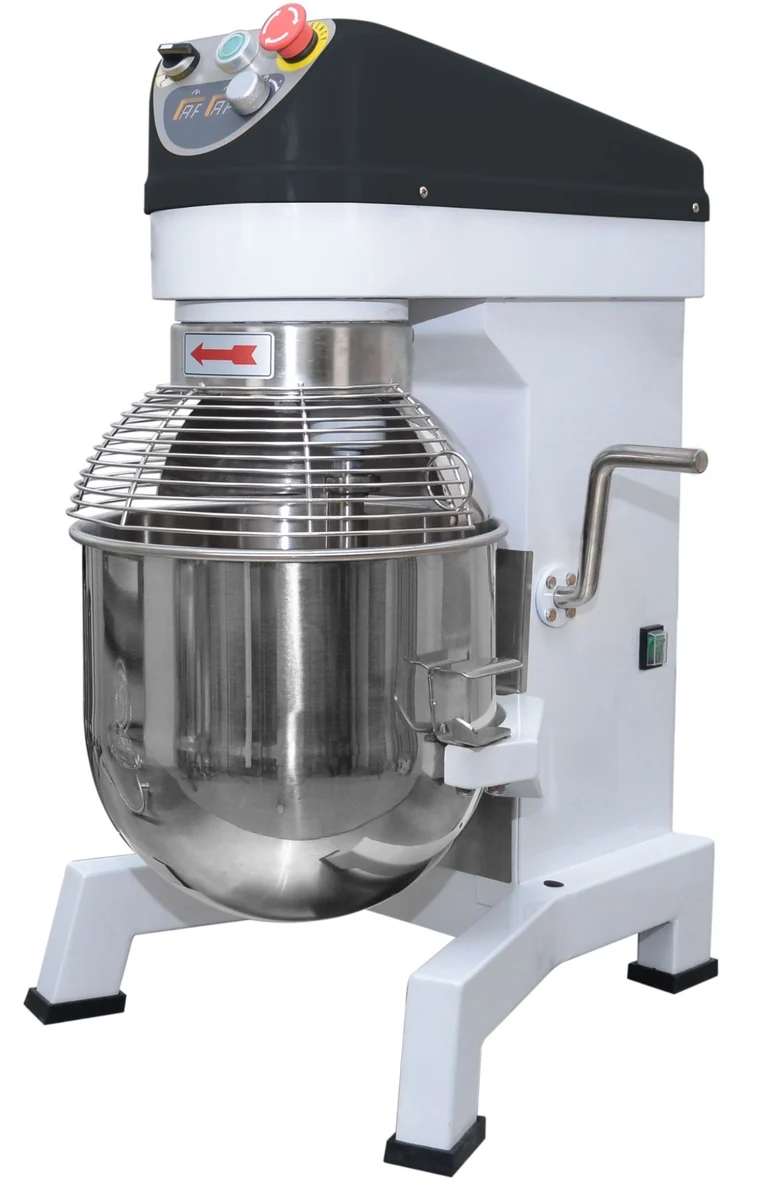
When you spec a CombiSteel planetary mixer, the bowl litres figure is only the physical size of the bowl. It does not protect the motor or your production plan.
For batch planning, use the manufacturer-rated limits for maximum flour load and maximum kneading (total dough) capacity, then match those to your recipes.
Here you can compare the stated capacities across the CombiSteel planetary mixer family (7534.0005, 7534.0010, 7534.0015, 7534.0020), see why there is no safe kg-per-litre shortcut, and use a simple method to total a recipe and check it against the manual.
Introduction to CombiSteel Mixer Capacities
CombiSteel mixer capacity is the manufacturer rating that tells you what a specific mixer can handle in day-to-day use. On these planetary models you will usually see three separate figures:
- Bowl volume (litres)
- Maximum flour load (kg)
- Maximum kneading load (kg) (total dough)
The key point: “20 L” is a container size, not a dough rating. There is no reliable rule that converts bowl litres into “kg of dough”, even within the same brand.
Bowl litres vs flour load vs kneading load (why there are three numbers)
- Bowl litres is a geometry number. It tells you what the bowl can hold.
- Flour load (kg) and maximum kneading load (kg) are working limits. They reflect what the drive system is rated to handle.
The CombiSteel planetary mixer manual lists separate capacities by model for the 7534.0005 / 7534.0010 / 7534.0015 / 7534.0020 family. For example, it shows the 7534.0010 as 20 L bowl, max kneading 7.5 kg, and max flour 5 kg (capacity table, p.5):
Manual 7534.0005-0010-0015-0020.pdf
Why capacity planning matters in Irish bakery and pizzeria operations
In a café bakery, takeaway pizza setup, or hotel pastry section, the mixer can be the pace-setter for prep. If you plan batches off bowl litres alone, it is easy to build a mix that physically fits but exceeds the rated flour or kneading load.
On the floor, it shows up as slower mixing, inconsistent dough development, more stops to scrape down, and avoidable wear when the machine is pushed during a busy prep window.
Planetary capacity is not spiral capacity
The CombiSteel models covered here are planetary mixers (the manual is titled “Planetery Mixer”, p.1). Planetary and spiral mixers work differently, so do not transfer capacity assumptions between types, even if the bowl size looks similar.
For buying and batch planning, treat capacity as model-specific and mixer-type-specific, and base your numbers on the stated flour and kneading limits for the machine in front of you.
Model-Specific Capacity Table
Use the manufacturer ratings below for production planning. They’re taken from the CombiSteel planetary mixer manual (capacity table, p.5):
Manufacturer-stated capacity table (planetary mixers)
Swipe or scroll horizontally to see all table columns.
| CombiSteel model | Bowl size (L) | Maximum flour (kg) | Maximum kneading, total dough (kg) |
|---|---|---|---|
| 7534.0005 | 10 | 2.5 | 3.75 |
| 7534.0010 | 20 | 5 | 7.5 |
| 7534.0015 | 30 | 7 | 10.5 |
| 7534.0020 | 40 | 9 | 13.5 |
Which limit should you plan around day to day?
Plan around both.
- If you only watch flour, you can still exceed the kneading limit once water and other ingredients are added.
- If you only watch total dough, you can still exceed the flour rating in a low-hydration recipe.
For a batch sheet, record both numbers (flour kg and total dough kg). It gives you a fast check that is easy to teach and easy to repeat.
Difference Between Planetary and Spiral Mixers
A planetary mixer rotates the tool around the bowl. A spiral mixer uses a spiral arm and a rotating bowl.
In practical terms:
- Planetary mixers suit sites that need one machine to cover multiple jobs (batters, creams, general prep, and some dough).
- Spiral mixers suit dough-led operations where kneading throughput and repeatability are the main goal.
The takeaway for capacity is simple: use the manufacturer’s flour and dough limits for the exact mixer type and model, not bowl litres.
If you are mapping a pizza prep routine around your order wave (mixing, balling, proving, cold storage, and dispatch), this layout guide helps you spot the real bottlenecks: Plan a pizzeria work line.
Recipe Calculation Example
This example is hypothetical. It shows the arithmetic you use to compare a recipe to the manufacturer limits. It is not a claim that any specific dough, hydration, speed, or method is approved by the manufacturer.
To size a dough recipe to the CombiSteel 7534.0010 planetary mixer, start with flour weight, calculate water from hydration, add the rest of the ingredients, then check two independent limits:
- Maximum flour load
- Maximum kneading (total dough) load
1. Start with the two limits (do not exceed)
For the CombiSteel 7534.0010 (20 L) planetary mixer, the manual lists:
- Maximum flour: 5 kg
- Maximum kneading (total dough): 7.5 kg
Source: CombiSteel manual (PDF hosted at media.caterboss.ie) (capacity table, p.5).
2. Convert hydration into water weight
Hydration is a percentage of flour weight.
Hypothetical example:
- Flour = 4.00 kg
- Hydration = 60%
- Water = 4.00 × 0.60 = 2.40 kg
Flour + water so far = 6.40 kg.
3. Add other ingredients to get total dough weight
Add the rest of the ingredients by weight.
Hypothetical example:
- Other ingredients = 0.16 kg
- Total dough = 4.00 + 2.40 + 0.16 = 6.56 kg
4. Check both limits
Compare your batch to both rated limits:
- Flour check: 4.00 kg ≤ 5.00 kg
- Kneading check: 6.56 kg ≤ 7.50 kg
If either one is over, the batch is over the stated rating.
5. If it does not fit, scale the whole recipe down (and recheck)
If your recipe is over on flour, total dough, or both, the cleanest fix is to scale the whole recipe down and then recheck both limits.
- Work out both scaling factors:
- Flour factor = (allowed flour) ÷ (your flour)
- Dough factor = (allowed total dough) ÷ (your total dough)
- Use the smaller factor (the tighter limit). Never scale up.
- Multiply flour, water, and all other ingredients by that same factor so your baker’s percentages stay consistent.
- Recheck:
- (new flour) ≤ (allowed flour)
- (new total dough) ≤ (allowed total dough)
6. Use the correct attachment for dough
The manual’s attachment guidance lists the hook for dough applications such as bread and roll dough and pizza dough (p.8). Source: CombiSteel manual.
Using Attachments Correctly
Pick the attachment that matches the type of mix, then keep the batch inside your model’s stated flour and kneading limits. Changing attachments is not a workaround for capacity.
1. Isolate the mixer before changing any attachment
Stop the mixer and isolate it from power before swapping accessories. The manual states: “Always disconnect or unplug power before cleaning, servicing or adjusting parts or accessories.” (p.7)
Source: 7534.0010 manual · PDF
2. Use the dough hook for dough work listed in the manual
The manual lists the hook for (among others): raised donut dough, pasta, heavy bread dough, bread and roll dough, and pizza dough (p.8).
3. Use the flat beater for batters and general mixing
The manual lists the flat beater for items such as waffle or hotcake batter, mashed potatoes, fondant icing, cake flat, and pie dough (p.8).
4. Use the wire whip for light aeration tasks
The manual lists the wire whip for light whipping jobs like cream, egg whites, and meringue (p.8).
The manual also notes that all models have 10 variable speeds under each agitator (p.8). That is a control feature, not proof that any speed suits any recipe.
Integrating Mixer Use in Commercial Workflows
Capacity only matters if the batch still fits your space, labour, and timing.
A practical way to keep production steady is to standardise two numbers on the batch sheet:
- Flour per batch (kg)
- Total dough per batch (kg)
Those are the two figures you can check quickly against the manual’s ratings.
Capacity planning starts with your bottleneck, not the bowl
If you are tight on benches, trays, racks, or cooling space, a bigger batch can make prep slower, not faster.
Before you increase batch size, check the full chain: ingredient scaling, mixing, dividing, proving, baking, cooling, packing, and storage. This is where layout planning earns its keep, especially in smaller Irish back-of-house spaces.
For a broader bakery view (workflow, equipment positions, and where congestion happens), use: Plan bakery equipment layout.
FAQs
What should you write on a batch sheet so staff stay inside the rating?
Keep it simple and measurable:
- Flour weight for the batch (kg)
- Total dough weight for the batch (kg)
- Attachment to use (hook, beater, or whip)
That gives you a quick cross-check against the two manufacturer limits (flour and kneading load) without relying on “it looks about right in the bowl”.
If a recipe is over the limit, what is the cleanest way to scale it down?
Scale the whole recipe down using the tighter of the two limits, then recheck both.
- Flour factor = (allowed flour ÷ your flour)
- Dough factor = (allowed total dough ÷ your total dough)
- Use the smaller factor and multiply every ingredient by it.
This keeps hydration and baker’s percentages consistent, which is what you want for repeatability.
Where in the manual do you find the figures that matter for capacity and attachments?
In the CombiSteel manual for these planetary mixers:
- The capacity table (bowl litres, max kneading, max flour) is on page 5.
- The safety instruction to disconnect or unplug before adjusting accessories is on page 7.
- The attachment recommendations (hook, flat beater, wire whip) and the note that all models have 10 variable speeds under each agitator are on page 8.
Source: Manual 7534.0005-0010-0015-0020.pdf
Need help choosing the right CombiSteel mixer size?
If you share your typical flour per batch, total dough per batch, and what you’re mixing (pizza dough, rolls, batter, cream), it’s straightforward to sanity-check against the manufacturer-rated limits.
For model availability and purchasing information, see: CombiSteel Planetary Mixer 20L.