
Guides · CombiSteel Knowledge Hub
Planning CombiSteel Planetary Mixer Batches for 600×400 Tray Loads (7534.0010 vs 7534.0020)
Explore CombiSteel planetary mixers for efficient bakery batch planning with 600×400 trays, adhering to Irish professional kitchen needs.
In this guide
You plan batches in kilograms, but you run production in 600×400 trays. The mixer you choose has to suit both.
This guide helps you size and schedule dough mixes using the CombiSteel planetary mixers 7534.0010 (20 L) and 7534.0020 (40 L), while staying inside the manual’s two independent caps: Maximum flour (kg) and Maximum kneading capacity (kg).
You will also see how a typical 600×400 staging counter can shape what happens after the mix, plus the key constraints from the official manual that affect day-to-day use.
Understanding CombiSteel Planetary Mixer specs (what matters for batch planning)
For batch planning, focus on bowl volume, the two separate load limits (kneading and flour), and the speed range you can verify from manufacturer sources.
Bowl capacity (20 L vs 40 L): useful, but not a weight conversion
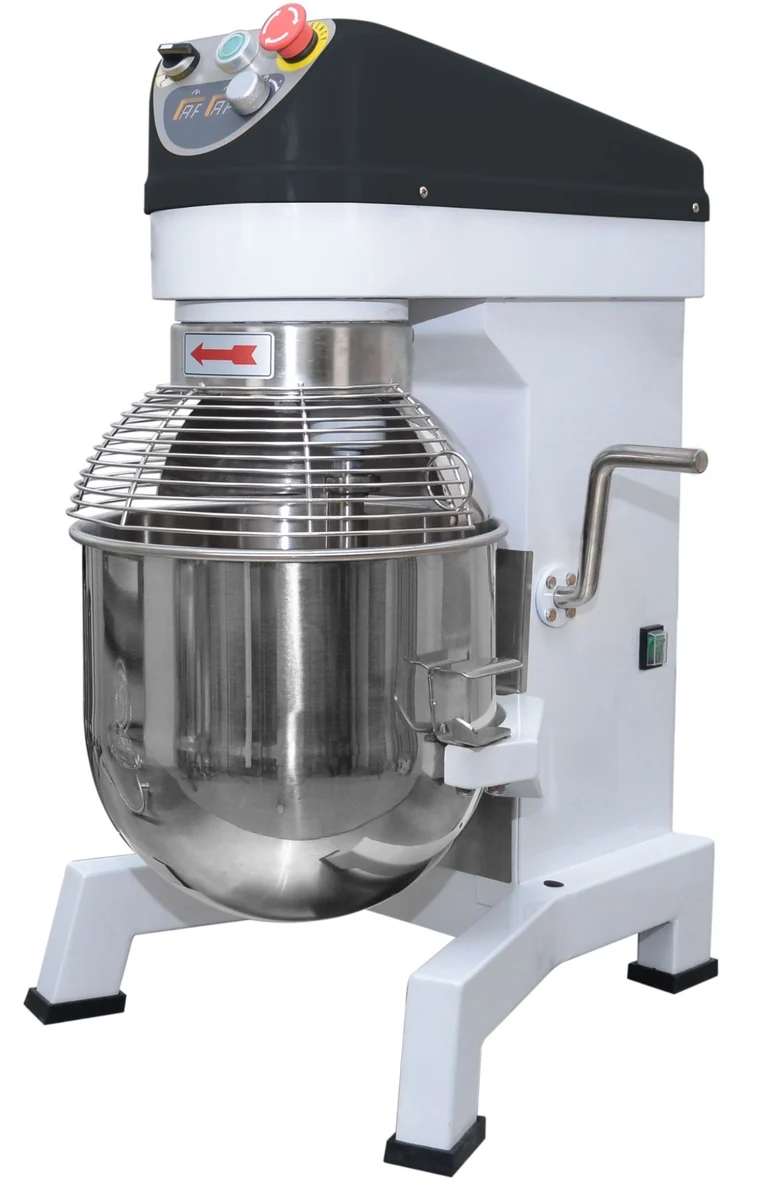
The 7534.0010 is the 20 L model and the 7534.0020 is the 40 L model, per the specifications table in the CombiSteel planetary mixer manual (models 7534.0010 and 7534.0020).
Bowl litres help you compare physical size. They are not a safe way to convert litres into kilograms of dough. For sizing a batch, work from the manufacturer’s stated load limits.
If you want a structured way to think about litres versus real load limits, see the CombiSteel mixer bowl litres vs flour and dough capacity guide.
Maximum kneading capacity vs maximum flour: treat them as two separate caps
The manual lists two different limits, and you need to stay within both:
- 7534.0010 (20 L): maximum kneading capacity 7.5 kg and maximum flour 5 kg
- 7534.0020 (40 L): maximum kneading capacity 13.5 kg and maximum flour 9 kg
These are separate fields in the specifications table in the CombiSteel planetary mixer manual (models 7534.0010 and 7534.0020). In practice, hydration and inclusions can push you into one limit before the other.
Speed range (10 speeds): what you can verify
Both mixers are 10-speed machines.
The manufacturer product pages publish these speed ranges:
- 7534.0010: 60–503 rpm on the CombiSteel 7534.0010 product page
- 7534.0020: 55–480 rpm on the CombiSteel 7534.0020 product page
The manual also includes multiple speed data table blocks listing rpm values by speed step for each model (manual, “6. SPEED DATA TABLE”). The tables are not explained (there are multiple blocks), so if you are writing SOPs, pick the settings you actually use and document them consistently.
Electrical spec note: manual and product page don’t match on frequency
The product pages list 230 V / 50 Hz for both mixers (7534.0010 product page, 7534.0020 product page). The manual lists 230 V / 50/60 Hz for both models (manual specifications table).
For an installation sign-off, don’t guess from paperwork alone. Check the rating on the unit nameplate and, where required, have a qualified installer confirm supply suitability.
Batch planning: a simple method that won’t breach the two caps
A practical order of work is:
- Start with flour weight, because it is explicitly capped.
- Calculate total batch weight from your full recipe (including salt, yeast, fat, seeds, inclusions).
- Confirm the finished batch stays at or below the manual’s maximum kneading capacity.
- Then check whether that batch rhythm fits your 600×400 staging and labour flow.
Matching the tool to the mix (manual guidance)
The manual’s agitator recommendations are a solid baseline:
- Hook: raised donut dough (65% AR), pasta, basic egg noodle, heavy bread dough (55% AR), bread and roll dough (60% AR), pizza dough (40% AR)
- Flat beater: waffle or hotcake batter, mashed potatoes, fondant icing, cake flat, pie dough
- Wire whip: whipping cream, egg whites, meringue
(From the CombiSteel planetary mixer manual (agitator recommendations).)
Your 600×400 reality check: staging can be the bottleneck
Batch planning falls apart if you are mixing faster than you can portion, tray up, and move product into the next step.
A representative 600×400 environment is the CombiSteel Standard Line Refrigerated Bakery Counter 2 Doors 7450.1215, specified with:
- Grid size: 600×400 mm
- Number of guide pairs: 12
(From the Caterboss listing for CombiSteel 7450.1215.)
That tells you the tray format and that the counter is configured around multi-level 600×400 rails. It does not prove how many usable tray levels you will get in your specific setup, so confirm the configuration if staging capacity is critical.
Worked example (hypothetical): keeping the batch legal, then checking trays with your own standards
This is a planning example, not a CombiSteel yield chart. The only “fixed” limits here are the two caps in the manual.
Assumptions (yours, for planning)
- Dough type: a bread/roll dough around 60% absorption (the manual lists “Bread and Roll Dough (60% AR)” under hook recommendations) (manual agitator table)
- Full recipe adds (example only): 2% salt and 2% fat (as a simple allowance beyond flour and water)
- Piece weight and pieces-per-tray: your choice (these are not specified by CombiSteel sources)
- Staging reference: a 600×400 counter like 7450.1215 with 12 guide pairs
Step 1: choose a batch that stays below both manual caps
If you are using the 7534.0010 (20 L)
Manual limits: 7.5 kg maximum kneading capacity and 5 kg maximum flour (manual specifications table).
Example choice (below both caps):
- Flour: 4.0 kg (below 5 kg cap)
- Water at 60%: 2.4 kg
- Salt at 2% of flour: 0.08 kg
- Fat at 2% of flour: 0.08 kg
Estimated dough weight = 4.0 + 2.4 + 0.08 + 0.08 = 6.56 kg
That stays below 7.5 kg kneading capacity and below 5 kg flour.
If you are using the 7534.0020 (40 L)
Manual limits: 13.5 kg maximum kneading capacity and 9 kg maximum flour (manual specifications table).
Example choice (below both caps):
- Flour: 8.0 kg (below 9 kg cap)
- Water at 60%: 4.8 kg
- Salt at 2% of flour: 0.16 kg
- Fat at 2% of flour: 0.16 kg
Estimated dough weight = 8.0 + 4.8 + 0.16 + 0.16 = 13.12 kg
That stays below 13.5 kg kneading capacity and below 9 kg flour.
Step 2: translate dough weight into pieces and 600×400 trays (worksheet method)
Once you have a compliant batch weight, the tray maths is yours. Keep it as a worksheet so you can change piece size or tray layout without rethinking the whole plan.
- Pieces =
(dough_kg × 1000) ÷ piece_weight_g - Trays =
CEILING(pieces ÷ pieces_per_600×400_tray)
At that point you can ask the operational question that matters: does this batch create more trays than you can comfortably stage, prove, bake, and clear?
Step 3: check staging against your available rails
A counter like the CombiSteel 7450.1215 is specified with 12 guide pairs. Use that as a reference point for how your cold prep is set up, then confirm what you can actually load in day-to-day use.
If your worksheet says one mix will produce a lot of trays, the mixer may not be the constraint. Staging space, cold holding and staff time usually are.
For tray formats and how 600×400 sits alongside other kitchen standards, see the CombiSteel GN and Bakery Tray Sizes Guide.
Safety and cleaning constraints you have to build into planning
If you are writing SOPs, start with the manufacturer’s manual. The points below are requirements from the manual.
- Restricted access: the manual states the owner should restrict access so only people aged 18+, properly trained and supervised, who have read and understood the manual, use the equipment. It also states customers and visitors should not come into contact with the mixer (manual, attention owners and operators).
- Installation basics: install in a work area with adequate light and space, on a solid, flat, non-slip, non-flammable surface. The manual warns against bypassing or modifying the device and against attempting to lift the mixer by yourself (manual, installation section).
- Bowl guard interlock: the manual states the mixer will not operate if the bowl guard is open or not properly installed (manual, bowl guard section).
- Cleaning constraints: the manual requires you to unplug before cleaning, prohibits hosing down or pressure washing, prohibits bleach-based cleaners and abrasive pads, and states the agitator should be removed after each batch to avoid it sticking on the shaft (manual, cleaning instructions).
- Dust hazard: the manual flags a dust hazard and advises adding ingredients such as flour carefully to minimise airborne dust particles (manual, dust hazard note).
Choosing between 20 L and 40 L for 600×400 production
Choosing between the 20 L and 40 L mixers is mostly about batch rhythm and what your line can absorb.
- If you are tight on staging space or staff time for scaling and panning, smaller batches can be easier to keep moving.
- If you have the tray rails, cold holding, and the flow downstream, fewer larger mixes can reduce changeovers.
For quick reference, here are the manufacturer-stated limits:
- 7534.0010 (20 L): 7.5 kg maximum kneading capacity, 5 kg maximum flour (manual specifications table)
- 7534.0020 (40 L): 13.5 kg maximum kneading capacity, 9 kg maximum flour (manual specifications table)
If you want to compare the manufacturer-published motor and speed-range specs:
- 7534.0010: 10 speeds, 60–503 rpm, 1 kW, “Max. 5kg flour” (CombiSteel 7534.0010 product page)
- 7534.0020: 10 speeds, 55–480 rpm, 1.5 kW, “Max. 9kg flour” (CombiSteel 7534.0020 product page)
Next step
Before you move up a mixer size, do the quick staging check: pick a compliant batch (below both caps), then use your own piece weight and tray layout to calculate how many 600×400 trays that mix will generate. Compare that with the guide-rail setup you actually have on the day.
To see what a 600×400 counter spec looks like, refer to the CombiSteel Standard Line Refrigerated Bakery Counter 2 Doors (600×400, 12 guide pairs) listing on Caterboss.