
Neutral equipment · CombiSteel Knowledge Hub
Choosing CombiSteel Stainless-Steel Worktables and Storage by Kitchen Task
Select the ideal CombiSteel worktables and storage for your kitchen needs with this practical guide for Irish hospitality.
In this guide
You’ll choose stainless-steel worktables and storage faster when you start with the task, not a “standard bench”. This guide shows how to plan a CombiSteel worktable around prep, cooking support, baking and packing, so you get enough clear surface and the right base style.
A compact reference point is CombiSteel 7333.0063, listed at 900 x 600 x 850 mm (W x D x H).
- Footprint source: Caterboss listing for CombiSteel 7333.0063
Understanding CombiSteel worktables (what’s confirmed, and what isn’t)
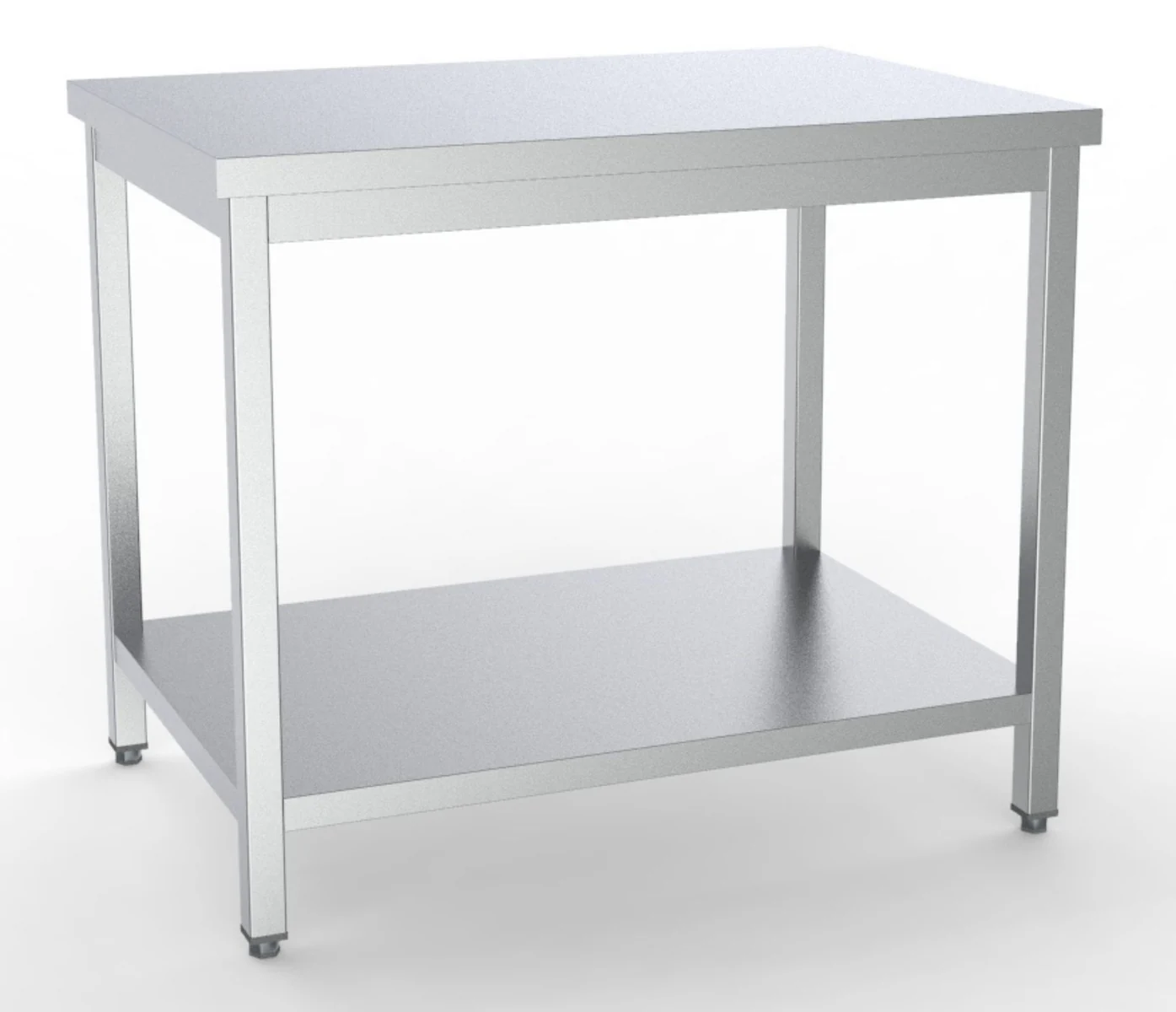
CombiSteel worktable 7333.0063 is listed as a 600 mm deep worktable with a bottom shelf. The technical data sheet lists the material as Stainless steel 430.
One detail to get right early is load ratings, because tables are often asked to do double-duty as equipment stands.
The CombiSteel technical data sheet for 7333.0063 states “Max. load capacity shelf (kg) 300”. That figure is for the undershelf. The same document does not state a maximum load rating for the worktop, so appliance support on the top needs separate, model-specific confirmation.
- Shelf rating and material source: CombiSteel 7333.0063 Technical Data Sheet (PDF)
If you want the background on this common misread, see: how to avoid misreading a shelf rating as worktop approval.
Choosing the right worktable size for your task
Choose worktable size by working backwards from the job.
1. Write the task as a sequence, not a label
“Prep table” is too vague. “Veg prep” in a café might mean a crate of produce, a salad spinner, two boards, a waste caddy and a GN of prepped items, all competing for the same 600 mm depth.
Do this for each task because the space needs change quickly between:
- wet prep (more containers, more wipe-down, more waste handling)
- dry prep and portioning (more scales, labels, bags, trays)
- bakery and pastry (more trays, more resting space)
2. Build a task surface inventory (template you can reuse)
Before you do any “width budgeting”, write down what actually lives at the station. This is what stops a table becoming a dumping ground, or a pinch point during a rush.
Use this as a fill-in template. If you’re using 7333.0063 as your reference, the available worktop footprint is 900 x 600 mm.
Swipe or scroll horizontally to see all table columns.
| Inventory line | What to record (fill in) | Notes for the decision |
|---|---|---|
| Task/station name | e.g. sandwich build, veg prep, pastry make-up, plating/packing | Keep it specific enough that two people would describe it the same way |
| Always-on (worktop) | Items that are there most of the shift | These are the true “non-negotiables” for surface space |
| Peak-time additions (worktop) | Items that appear together during your busiest 30 minutes | This is usually where the bench “fails” in real service |
| “Creepers” (worktop) | Things that migrate in: scales, wrap dispenser, labels, docket printer | If it keeps landing there, plan for it |
| Undershelf candidates | Items you want close but not on the top | For 7333.0063, the undershelf is the only area with a declared load rating (300 kg max) |
| Waste/cleaning at the station | waste caddy, bin position, sanitiser, roll, cloth storage | If these have no home, they end up on the worktop |
| Clear work zone needed | What needs genuinely clear space (and roughly how much) | Write “clear” in plain English, then measure your kit |
Where you know the table size, plan to the real footprint. CombiSteel 7333.0063 is listed at 900 x 600 x 850 mm (W x D x H).
3. Worked example: width budgeting on a 900 mm table (planning method)
This is a planning check only, not a manufacturer approval and not a statement of what you “should” do.
Example task: sandwich and deli prep during a busy lunch.
Items that tend to be on the top together:
- chopping board for assembly
- a small set of ingredient containers
- a wrap/pack area
A simple width budget on a 900 mm table (illustrative placeholders):
- Container zone: ~300 mm
- Clear working zone: ~450 mm
- Packing zone: ~150 mm
Total: 300 + 450 + 150 = 900 mm.
Treat those numbers as placeholders and swap them for your real measurements (board size, container footprints, packaging area). The point is to expose when the “clear work” patch disappears.
If your “must-have” list also includes a fixed appliance on the worktop, something has to give. In practice, that usually means a longer bench, a separate stand, or moving containers off the surface so you keep a genuinely clear working patch.
A quick way to sense-check this in your own kitchen is to tape out 900 mm on an existing counter and lay the actual kit down the way it sits during service.
4. Confirm the table doesn’t create a pinch point
A worktable that fits on paper can still fail when two staff pass, a dishwasher rack comes through, or a bin pull-out opens beside it.
This is where 600 mm depth can be either ideal or limiting. On a tight line it keeps reach short. On a bakery bench you can run out of tray space and end up parking trays elsewhere, which slows everything down.
Assessing worktable base choices
The base you choose decides whether the station stays flexible, becomes useful “at-hand” storage, or turns into a closed unit that keeps clutter under control. The trade-off is protection versus access.
Open base
Choose an open base when you want the table to stay a pure working surface and you already have proper racking or shelving nearby. It also suits tight kitchens where seeing under the table matters for floor access.
Undershelf
An undershelf suits task-focused stations where you can clearly define what lives under the table: bowls, tubs, boards and small items that move on and off.
If you are looking at 7333.0063, the only declared load in the technical sheet is for the shelf: 300 kg max. The worktop load is not stated.
Cabinet base
A cabinet base can suit stations where you want cleaner, more predictable storage, especially in dusty areas or where “open” storage becomes messy during service.
The downside is discipline. Doors hide problems as well as mess, so you need a routine that stops “closed” becoming “forgotten”.
Which is best for you?
- If the zone is wet, high-turnover, or cleaned in short bursts, lean open base unless you have a controlled reason to store underneath.
- If the zone is prep-heavy and you keep reaching for the same items every few minutes, an undershelf is often the best balance, provided it stays organised.
- If the zone is dusty, customer-facing, or prone to clutter, a cabinet base can improve consistency, but only if someone owns cleaning inside it.
Combining tables and storage for efficiency
Start with the job the table is meant to do and keep only the matching storage within arm’s reach. Use wall shelving or racking for bulk so you don’t end up loading the worktop like a storeroom.
1. Treat the worktable as a station, not overflow storage
Give each table one primary role in your kitchen flow, for example veg prep near the wash-up, pastry make-up near the mixer, or packing beside the pass.
If you’re planning around a known footprint, treat it as fixed. CombiSteel 7333.0063 is listed at 900 x 600 x 850 mm.
2. Choose storage based on speed, splash and segregation
- Open base / undershelf: best where you need fast, visible access.
- Cabinet base: better where you want cleaner storage and more control over what ends up in the station.
3. Plan your full run for baking and pastry
If you are setting up a pastry or bakery corner, plan the full run, not just the bench. See: plan a bakery equipment layout that suits your workflow.
FAQs on worktable arrangement and load capacity
If I need to put a heavy appliance on the worktop, what exactly should I ask for?
Ask for a declared maximum worktop load rating for the exact table model, and ask whether the rating depends on how the load is applied (for example, spread across the surface versus concentrated on small feet).
For 7333.0063, the manufacturer document provided lists a max load for the shelf (300 kg), but it does not declare a worktop load rating.
- Source document: CombiSteel 7333.0063 Technical Data Sheet (PDF)
How do I stop an undershelf becoming a dumping ground?
Decide what the shelf is for in one sentence, then match it to your inventory.
A simple rule that works in real kitchens is: store only the items that directly support the station’s main task (plus one backup), and move everything else to racking. The moment you mix “prep kit” with “random storage”, it gets slower to work from and harder to clean.
Next step
If you’re pricing a compact prep or landing station, start by confirming the footprint and the declared shelf load for CombiSteel 7333.0063, then check it against your task surface inventory and traffic route.
- Product listing: CombiSteel 600 worktable with bottom shelf 900 mm
- Manufacturer document: CombiSteel 7333.0063 Technical Data Sheet (PDF)